





In the competitive SaaS landscape of 2026, simply building a great product is no longer enough. Enterprise buyers expect solutions that align seamlessly with their existing cloud commitments, meet stringent security and operational standards, and deliver predictable value. This is where the AWS Foundational Technical Review, commonly known as AWS FTR, becomes a critical milestone for any team serious about scaling through cloud marketplaces.
The AWS FTR is a structured validation process designed specifically for AWS Partner Network members. It helps software providers identify and remediate risks in security, reliability, and operational excellence before their solutions go live on AWS Marketplace or engage in co-sell motions. For growth-stage SaaS companies, passing the FTR is often the difference between watching committed cloud budgets flow elsewhere and capturing them as predictable revenue.
Recent updates in 2026 have made the process significantly more accessible. AWS Partner Central now accepts SOC 2 Type II reports or recent Well-Architected Framework Reviews for expedited validation, often delivering feedback in minutes rather than weeks. This change, powered in part by Amazon Bedrock for AI-assisted reviews, reflects AWS's push to reduce friction for innovative partners while maintaining high standards. Partners can submit in multiple languages and receive targeted remediation steps immediately.
At Missioned, we work with SaaS teams every day who are navigating this exact journey. Our platform turns the operational complexity of marketplace motions, including compliance steps like the FTR, into automated, repeatable processes so your team can focus on closing deals instead of chasing reviews.
What exactly is the AWS foundational technical review?
The AWS Foundational Technical Review (FTR) is a self-service yet validated assessment that evaluates your software solution against a targeted subset of the AWS Well-Architected Framework. It focuses on three core pillars: security, reliability, and operational excellence.
Unlike a full Well-Architected Review, the FTR is streamlined for software solutions, whether delivered as SaaS or customer-deployed. It examines key areas such as identity and access management best practices, vulnerability management and network security, data handling and encryption, backup and recovery strategies, S3 bucket configurations, cross-account access controls, and regulatory compliance readiness.
Passing the FTR demonstrates that your solution follows AWS best practices, reducing risk for both you and your customers. The review is valid for three years from approval and remains free for eligible partners. It is not strictly mandatory for basic AWS Marketplace listings, but it is essential for unlocking advanced benefits and enterprise trust.
The process evolved from earlier technical baseline reviews and now integrates more deeply with tools like the AWS Well-Architected Tool. This makes it accessible at any stage of your cloud journey, whether you are just launching your first marketplace listing or scaling an established product.
Why the AWS FTR matters more than ever in 2026
Enterprise procurement has shifted decisively toward cloud marketplaces. Buyers prefer solutions listed on AWS Marketplace because purchases draw from pre-committed budgets, often with faster approval cycles and built-in security assurances. Without an approved FTR, many advanced partner programs remain out of reach.
The review serves as a prerequisite or strong enabler for several high-value opportunities:
- AWS ISV Accelerate Program participation, which unlocks co-sell opportunities with AWS field teams
- Eligibility for AWS Competency and Service Ready specializations
- The “Qualified Software” badge and enhanced visibility in the AWS Partner Solutions Finder
- Reduced AWS Marketplace listing fees, marketing development funds, and other partner incentives
- Stronger positioning during enterprise security and procurement reviews
Industry data underscores the impact. Partners who achieve FTR approval and subsequent program access frequently see meaningful uplifts in deal velocity and win rates. According to various benchmarks, co-sell motions through programs unlocked by FTR can deliver 2x faster deal cycles and larger average deal sizes.
Moreover, the FTR process itself drives architectural improvements. Teams routinely discover and close security gaps, optimize costs, strengthen operational resilience, and improve overall product reliability, outcomes that pay dividends far beyond marketplace participation. In a market where cloud partner-influenced deals continue to grow, technical validation like the FTR signals maturity to buyers who conduct rigorous vendor assessments.
For growth-stage SaaS companies, the stakes are particularly high. You often compete against larger players with dedicated compliance teams. Completing the FTR levels the playing field by proving your solution meets the same standards expected in enterprise environments, without requiring massive internal overhead.
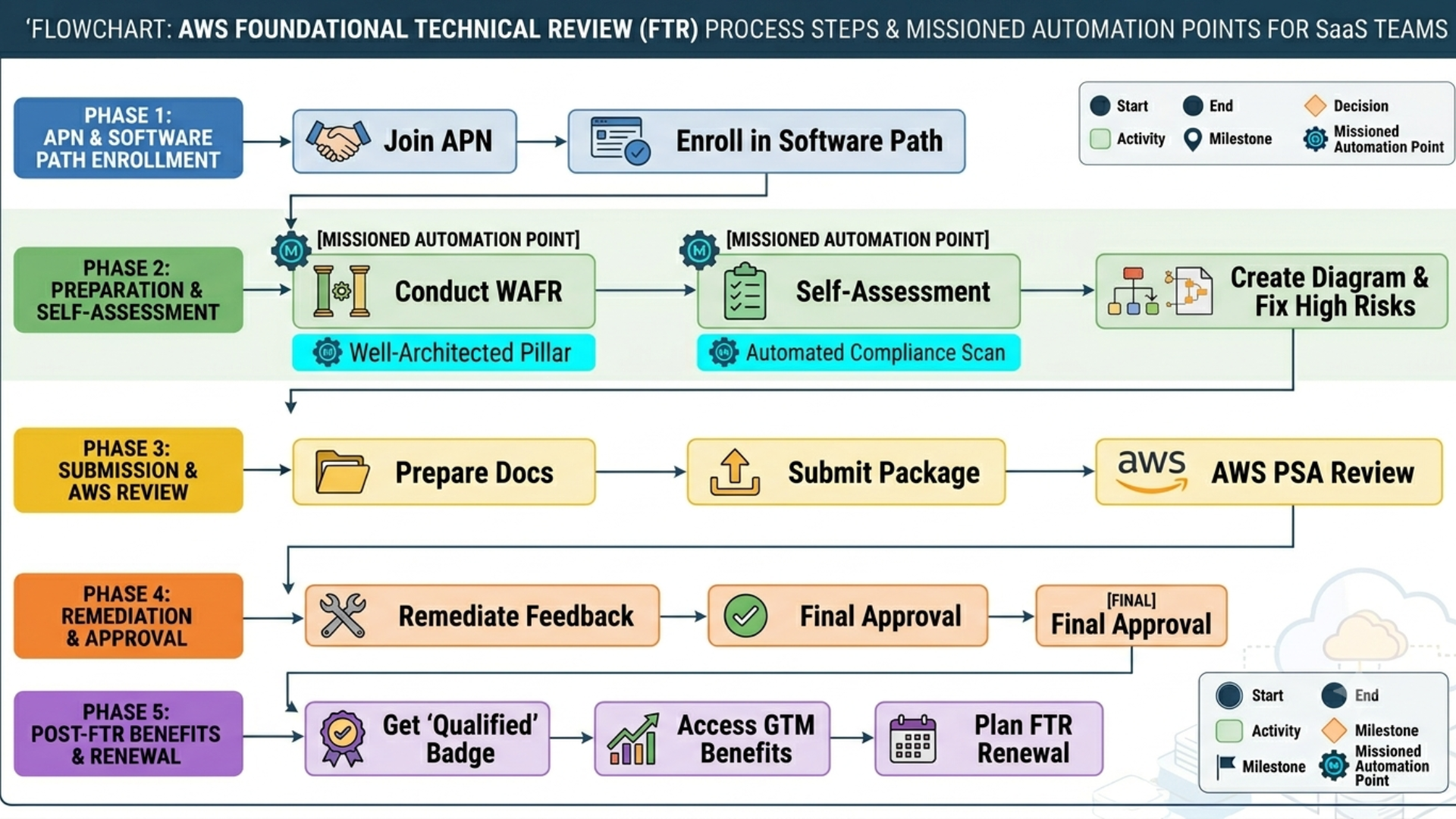
Step-by-step guide to completing your AWS foundational technical review
Navigating the FTR does not need to be overwhelming. Here is a practical, battle-tested sequence based on current 2026 processes:
- Join the AWS Partner Network and enroll in the Software Partner Path Register your company at no cost and select the appropriate path. This establishes your foundation in Partner Central.
- Prepare your solution profile Create or update your solution listing in AWS Partner Central. Ensure all required fields, including detailed descriptions, use cases, and technical specifications, are complete and accurate.
- Conduct self-assessment using the official checklist Download the latest FTR validation checklist. Review your architecture across all relevant accounts and regions. Pay close attention to security controls, data protection mechanisms, monitoring setups, and resiliency patterns.
- Leverage supporting validations for faster approval In 2026, submitting a current SOC 2 Type II report or a recent Well-Architected Review can dramatically accelerate the process, sometimes to minutes. This alternative pathway recognizes industry-standard compliance and reduces duplicative effort.
- Accept ACE terms and share opportunities Prepare pipeline visibility by accepting ACE terms and sharing select sales opportunities through the ACE Pipeline Manager. This step aligns your motion with AWS sales teams.
- Submit for review Upload your completed checklist and supporting documents via Partner Central under the solution's Validation tab. The system, enhanced with AI, processes submissions efficiently.
- Address any findings and re-submit Most teams achieve approval after addressing a manageable set of items. Document remediations clearly for traceability.
- Maintain compliance and plan for renewal With the validity period now extended to three years, schedule periodic internal checks. Continuous monitoring ensures you stay ready for re-validation and ongoing benefits.
Typical timelines range from days for well-prepared teams with strong supporting documentation to several weeks for those addressing significant gaps. Automation tools and experienced guidance can compress this substantially, turning what once felt like a months-long project into a focused initiative.
Common challenges and how to overcome them
Many SaaS teams encounter similar roadblocks during FTR preparation. Fragmented documentation across tools makes evidence collection painful. Cross-team coordination between engineering, security, operations, and compliance often creates bottlenecks. Keeping pace with evolving AWS requirements demands ongoing vigilance, and growth-stage teams rarely have dedicated compliance staff.
Additional challenges include aligning architecture with the specific FTR lens of the Well-Architected Framework, preparing for potential remediation cycles, and maintaining evidence that will satisfy both AWS reviewers and enterprise buyers.
Successful teams address these by centralizing visibility, automating evidence gathering, and treating the FTR as part of a broader compliance and marketplace strategy rather than a one-off project. This approach not only speeds up approval but builds long-term operational maturity.
Learn how Missioned supports broader compliance automation in our Cloud Compliance Automation capability.
Real-world benefits: From review to revenue
Teams that complete the FTR consistently report multiple advantages. Faster marketplace listing approvals and access to co-sell pipelines can significantly boost deal velocity. Stronger buyer confidence during procurement shortens sales cycles. Improved internal architecture reduces operational risk and long-term costs. Eligibility for marketing funds and incentives further accelerates growth.
Partners in ISV Accelerate and related programs often see 41% faster growth in their AWS Marketplace business compared to overall software revenue. Co-sell motions deliver higher close rates and larger deals. When combined with effective private offers management, CRM synchronization, and revenue operations, the impact compounds rapidly.
Real examples from the ecosystem show companies achieving hundreds of millions to billions in marketplace revenue after strengthening their technical foundation. The FTR serves as a foundational enabler in these success stories, providing the credibility and program access needed to compete effectively for committed cloud spend.
How Missioned helps saas teams conquer the FTR and beyond
At Missioned, we built our platform specifically for growth-stage SaaS companies that want marketplace momentum without enterprise overhead. While the FTR itself is an AWS-led process, we reduce the surrounding friction that often delays marketplace launches and revenue realization.
Our capabilities help you maintain clean, synchronized listings across cloud marketplaces, automate private offer workflows that align with FTR-validated solutions, ensure ongoing compliance posture through integrated monitoring, sync all marketplace activity bidirectionally with your CRM, and streamline revenue recognition and attribution for accurate reporting.
By handling the operational layer, from listings to deals to revenue, Missioned lets your team treat the FTR as a strategic accelerator rather than a bottleneck. Many of our customers complete their technical validations and move swiftly into revenue-generating marketplace motions within weeks, not months.
Frequently asked questions
What is the main purpose of the AWS Foundational Technical Review?
The FTR helps partners identify and fix risks in security, reliability, and operations so their solutions meet AWS best practices and qualify for advanced partner benefits.
How long does the AWS FTR process typically take?
Timelines vary based on preparation. Well-documented solutions with SOC 2 or Well-Architected support can achieve approval in days or even minutes, while others may need several weeks for remediation.
Is the AWS FTR required for AWS Marketplace?
It is not strictly required for basic listings but is essential for full marketplace success, co-sell programs, and many enterprise buyer preferences.
Can SOC 2 replace the full FTR?
Yes, in the 2026 streamlined process, a current SOC 2 Type II report often satisfies core requirements for rapid validation.
How does Missioned support teams pursuing FTR?
Missioned automates marketplace operations, compliance visibility, and revenue processes that complement your FTR efforts, helping you launch faster and scale revenue predictably.
How often must you renew the AWS FTR?
The review is valid for three years. Planning periodic internal checks helps ensure continuous compliance.
Ready to turn technical validation into revenue momentum?
The AWS Foundational Technical Review is more than a checkbox, it is your foundation for credible, scalable growth through cloud marketplaces. Teams that approach it strategically position themselves to capture committed enterprise budgets effectively.
If you are preparing for your FTR or already looking ahead to marketplace acceleration, our team can help map the most efficient path forward. Book a GTM session today. We will review your current setup, identify quick wins, and outline exactly how Missioned can help you move from validation to closed deals faster.