






AWS Partner Central quietly became one of the more interesting places in the AWS ecosystem to watch. In March 2026, AWS shipped a set of generative AI agents built directly into the console, accessible both through conversation and through the Model Context Protocol, the same open standard behind most of the current agent tooling ecosystem.
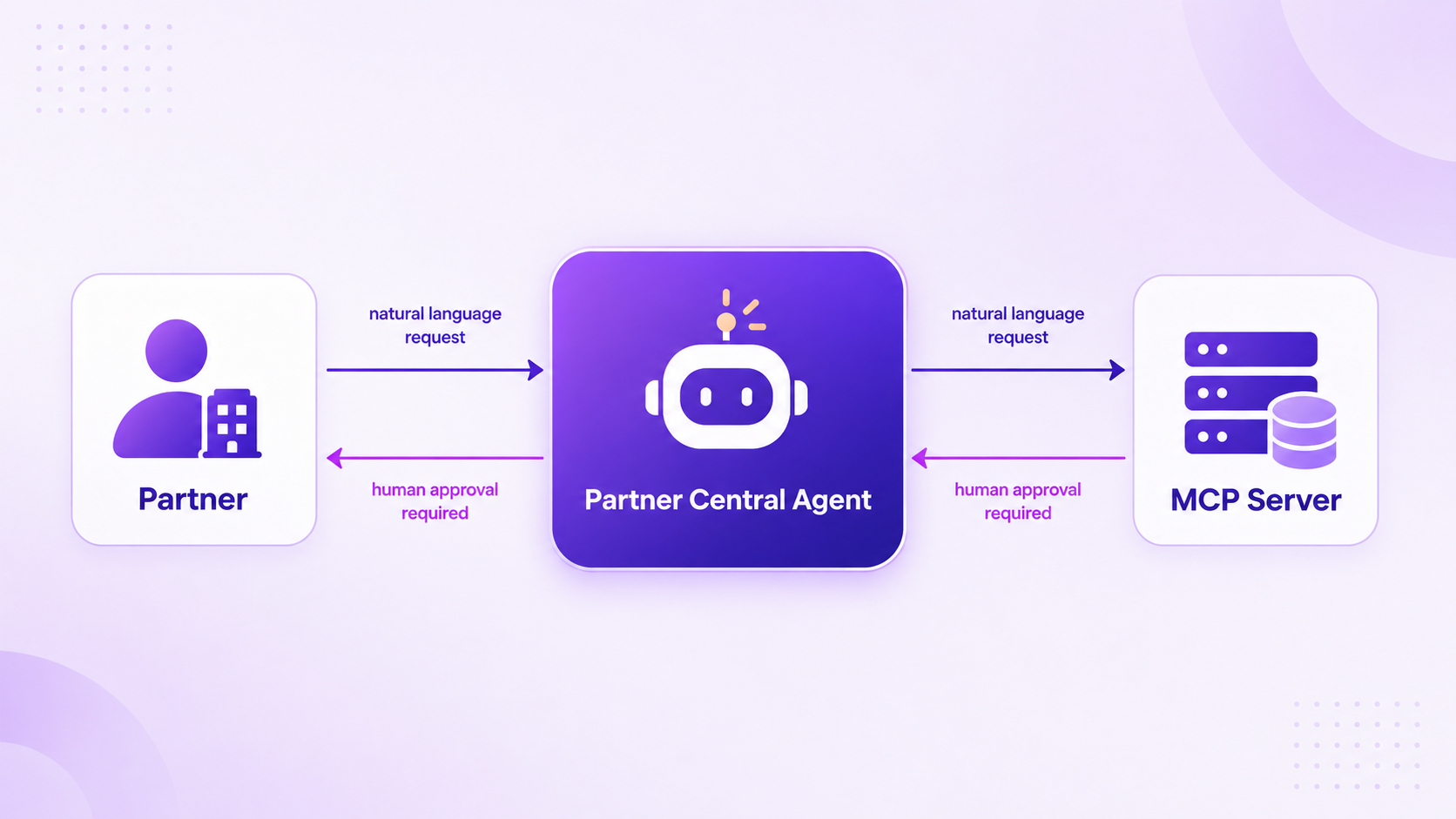
In plain terms: AWS Partner Central agents are generative AI agents, built on Amazon Bedrock AgentCore, that live inside the AWS Partner Central console and handle a defined set of partner and co-sell tasks on request. Partners can reach them by typing a question in the console, or programmatically through a dedicated MCP server that connects the agents to a partner's own tools and CRM. Every action that changes data requires a human's explicit approval first. The rest of this piece covers what they do, how they're accessed, and the guardrails AWS built around them.
What AWS Partner Central agents actually are
AWS migrated Partner Central into the AWS Management Console in late 2025, and the agents arrived a few months later, reaching general availability on March 16, 2026. They're built on Amazon Bedrock AgentCore, AWS's managed runtime for agentic workloads, which places them squarely inside AWS's own agent infrastructure rather than a bolt-on chatbot layered over an existing product.
Availability is worth stating plainly rather than glossing over: these agents are currently available only to partners who have migrated to the new Partner Central experience in the console. If your team hasn't made that console migration yet, this capability simply isn't available to you yet.
The full range of what they do
It's tempting to focus on a single headline feature, but the actual capability set is broader than any one piece of it, and understanding the whole set matters for judging where this is genuinely useful.
Pipeline insights. Natural-language queries over a partner's own pipeline, the kind of question that used to mean opening three dashboards to answer.
Opportunity summaries and creation. Partners can share meeting notes, transcripts, or emails, and the agent populates opportunity fields and advances deals rather than requiring manual data entry.
Sales play generation. Tailored, next-step recommendations based on where a given deal actually stands.
Customer profile creation. Building out account context without a partner having to assemble it by hand from scattered sources.
Funding recommendations. Proactive guidance on program eligibility, incentive amounts, and available SCA budget, delivered inside the seller's existing workflow rather than requiring a separate lookup.
AI-assisted product listing. Generating AWS Marketplace listings from a seller's existing digital assets, scoring listing strength against AWS's own standards, and providing field-level recommendations to improve discoverability. We've covered agentic AI listing itself in more depth separately.
Six distinct capabilities, all reachable from the same underlying agent layer, which is a meaningfully different design than shipping six separate point tools.
How sellers actually use them
There are two paths in, and they serve different needs.
The first is conversational, directly inside the Partner Central console. A partner types a question or request in natural language, and the agent handles it, no navigating multi-step forms or hunting through menus to find the right screen.
The second is programmatic, through the Partner Central agents MCP server, a fully managed, AWS-hosted endpoint that uses JSON-RPC 2.0 over HTTP. This is where things get genuinely interesting for a partner with an existing CRM or internal tooling. Rather than replacing what already works, a partner can build a lightweight orchestrator, their own agent, that talks to AWS's hosted Partner Central agent over MCP. AWS describes this as agent-to-agent communication, and it inverts how integration normally works: instead of a partner's team having to learn every field, validation rule, and payload structure of Partner Central's API, their own agent expresses what it wants accomplished in natural language, and AWS's agent handles how that gets done, including the business rules and validation, on the AWS side.
The guardrails AWS built in
This is the section worth reading closely if the idea of an AI agent touching your pipeline and opportunity data makes you cautious, since that caution is reasonable and AWS clearly designed around it.
Human-in-the-loop on every write. Any operation that changes data, creating an opportunity, updating a record, submitting something, requires the partner's explicit approval before it executes. The agent can prepare and recommend, but it cannot act unilaterally on data that matters.
Two-level IAM permissions. Access splits into protocol access, the ability to communicate with the MCP endpoint at all, and data access, the ability to actually perform Partner Central operations. A partner can grant fine-grained permissions at each level independently, which means access can be scoped tightly rather than granted as an all-or-nothing switch.
Sandbox testing. Partners can validate an integration or workflow in an isolated environment before it ever touches production data, a meaningful detail for any team building against this programmatically for the first time.
Put together, this is a considered access model, not an agent given free rein over a partner's account.
Why this matters now
It's worth being honest about where this actually sits. Availability is still limited to partners on the new console experience. The term "MCP Agents" itself is still forming inside the wider AWS ecosystem, most existing search interest and content around "MCP" points at the broader Model Context Protocol landscape generally, not this specific implementation. There isn't yet a large body of independent writing explaining what AWS actually built here.
That's precisely why it's worth understanding now rather than later. AWS has a track record of expanding console capabilities outward from an initial limited rollout, and partner tooling built on an open, documented protocol like MCP tends to get adopted faster once early explanations exist for people encountering it for the first time. Connecting the dots between what AWS shipped and what it actually means for a seller's day-to-day work is exactly the kind of groundwork worth laying early.
A few clarifications worth having upfront
Are AWS Partner Central agents the same as the general AWS MCP Server? No. The general AWS MCP Server is a broader developer toolkit for giving AI agents access to AWS APIs generally. Partner Central agents are a distinct product, purpose-built for co-sell and partner workflow tasks inside Partner Central specifically.
Can an AI agent submit or change data in Partner Central without a person approving it first? No. Every write operation requires explicit human approval before it executes. The agents can prepare and recommend actions, but they can't complete them unilaterally.
Do I need to use the MCP server, or is the console chat interface enough? Either works depending on the need. The console interface is straightforward for ad hoc questions and tasks. The MCP server matters specifically if a partner wants to connect these agents to their own CRM or internal tooling programmatically.
Is this available to every AWS Partner right now? Only to partners who have migrated to the new AWS Partner Central experience in the console. It isn't universally available yet.
We'll be tracking how this capability develops as adoption grows and the term itself becomes more established across the ecosystem.
Where this fits into your GTM motion
Capabilities like this are a preview of where AWS is taking partner tooling, but they don't remove the underlying work of getting co-sell, listings, and CRM sync actually running well for your team. If you're navigating the Partner Central migration, evaluating your Marketplace listing strategy, or just want a clearer picture of what's changing in this ecosystem, book a GTM session with our team.