


.png)



Growth-stage SaaS leaders operate in a high-stakes environment where every sales motion must deliver efficiency and predictable revenue. Traditional direct sales cycles often stretch into months of procurement friction, security reviews, and budget negotiations. Meanwhile, enterprise buyers sit on substantial committed cloud spend through programs like AWS Enterprise Discount Program (EDP) and Mutual Agreement for Committed Cloud (MACC) commitments. AWS Marketplace positions your product directly in front of that allocated capital, transforming how growth-stage independent software vendors (ISVs) acquire, close, and expand enterprise customers.
The platform delivers far more than a digital storefront. It provides structured access to committed budgets, accelerated procurement pathways, co-sell incentives that activate AWS field teams, and operational efficiencies that reduce sales friction across the buyer journey. In 2025 and 2026, these advantages have become even more pronounced as AWS continues refining programs like ISV Accelerate and the expanded SaaS Co-Sell Benefit.
This thought-leadership piece explores the core AWS marketplace benefits that matter most to growth-stage SaaS executives. Drawing on recent Forrester studies, AWS partner benchmarks, and real-world outcomes, we break down how forward-thinking teams are prioritising the channel to capture more revenue with less overhead. Whether you are preparing your first listing or optimising an existing presence, these insights will help you build a more resilient go-to-market motion.
Why committed cloud budgets make AWS Marketplace a strategic imperative
Enterprise customers increasingly sign multi-year commitments with AWS to secure favourable pricing and predictable cloud economics. Purchases routed through AWS Marketplace directly count toward these EDP and MACC obligations, creating powerful alignment between buyer incentives and your sales goals.
Buyers prefer solutions that help them retire committed spend efficiently rather than requesting incremental budget approvals. This dynamic shifts the conversation from “Can we afford this?” to “How quickly can we deploy it against our existing commitment?” Industry data shows that Marketplace transactions help enterprises maximise the value of their AWS investments, often making listed solutions the default choice during procurement.
For growth-stage SaaS companies, this represents a critical advantage. Your ideal customers already hold unused or expiring committed dollars. By listing on AWS Marketplace, you position your product to capture that spend without competing in traditional budget cycles that favour incumbents. Partners leveraging this approach report consistent revenue contributions, with Marketplace deals often closing faster and with higher predictability than direct sales.
Recent program refinements further strengthen this benefit. As of 2025 updates, eligible SaaS offerings hosted on AWS qualify fully for commitment drawdown, reinforcing the platform’s role as the preferred procurement vehicle. Growth-stage teams that integrate Marketplace strategy early find themselves competing less on price and more on demonstrated value and seamless integration.
Shorter procurement cycles that accelerate deal velocity
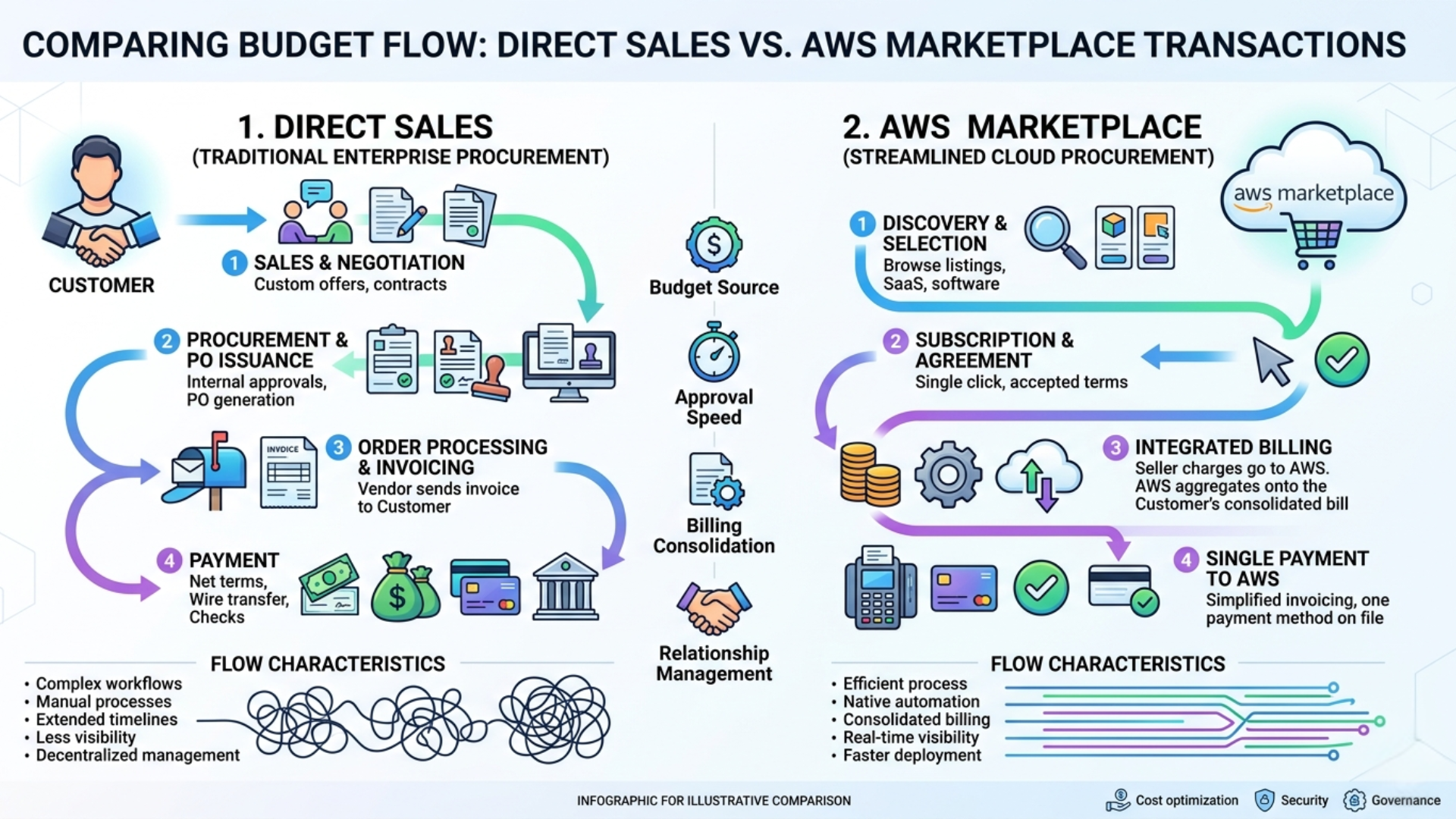
One of the most cited AWS marketplace benefits is the dramatic reduction in sales cycle length. Traditional enterprise software procurement can take five to six months due to legal reviews, security assessments, and multi-stakeholder approvals. AWS Marketplace standardises much of this process through pre-approved terms, consolidated billing, and streamlined procurement paths.
Forrester Consulting’s Total Economic Impact studies consistently highlight significant time savings. Organisations using AWS Marketplace report up to 60% faster procurement processes and 70% reduction in solution discovery time. ISVs transacting through the platform often see sales cycles compressed by 30-50%, sometimes reducing average timelines from five months to under three.
Private Offers amplify this advantage. Sellers can negotiate custom pricing, multi-year terms, and specific EULAs while buyers still benefit from Marketplace procurement simplicity. Express Private Offers, introduced in late 2025, allow qualified buyers to receive personalised offers in minutes rather than weeks of back-and-forth.
For growth-stage SaaS teams with lean sales organisations, this efficiency is transformative. Your representatives spend less time on administrative tasks and more on discovery, demos, and expansion conversations. Billing, collections, metering, and disbursements are handled by AWS, reducing finance and operations burden. Case studies from SaaS companies accelerating time-to-market on AWS show listings becoming operational in weeks, with first revenue following shortly thereafter.
Co-sell eligibility that turns AWS into an extension of your sales team
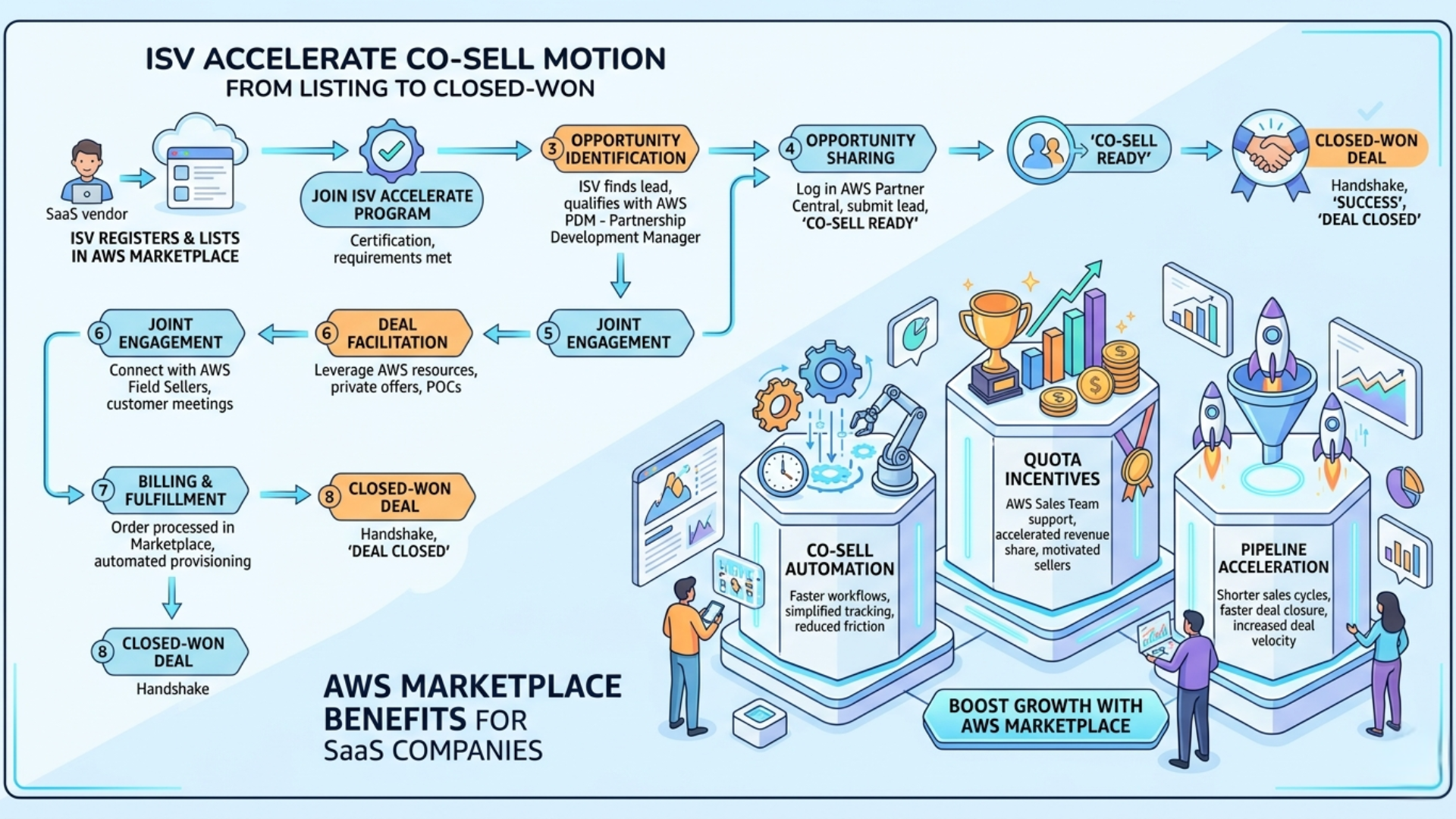
Perhaps the highest-leverage AWS marketplace benefits emerge through co-sell programs. Once enrolled in ISV Accelerate and actively transacting via Marketplace Private Offers, your solution gains visibility in AWS seller tools and recommendation engines. The expanded SaaS Co-Sell Benefit (rolled out broadly in 2025) provides AWS account managers with quota retirement credit for successful co-sold deals.
This incentive alignment drives measurable outcomes. Canalys and AWS partner data from 2025-2026 show co-selling partners achieving 51% higher average revenue growth, 65% reporting faster close rates, and 54% closing larger deals. ISV Accelerate participants in 2025 recorded 41% year-over-year growth in customer wins, 13% increase in Marketplace total contract value, and 16% growth in private offer volume.
Forrester’s analysis of AI-on-AWS ISVs revealed a 176% ROI over three years, with the majority of value coming from co-selling and Marketplace motions rather than pure technology differentiation. Partners saw 12% more deals won, 20% larger deal sizes, and 80% richer Marketplace transactions.
Growth-stage SaaS leaders particularly benefit here. Instead of solely relying on your own outbound efforts, you gain active support from AWS field teams who now have skin in the game. Joint account planning, shared pipeline visibility, and co-marketing opportunities become standard, creating a multiplier effect on your pipeline without proportional headcount increases.
Reduced sales friction and operational efficiencies
Beyond budgets and velocity, AWS Marketplace systematically lowers friction across the buyer and seller journey. Listings undergo technical review, providing buyers with confidence in security and integration standards. Flexible consumption models, including pay-as-you-go, contracts, free trials, and metering, match modern SaaS preferences.
Additional advantages include:
- Global reach without building separate regional procurement relationships
- Accurate revenue attribution and recognition through built-in reporting
- Simplified compliance and tax handling for Marketplace transactions
- Access to marketing development funds (MDF) and co-marketing programs for enrolled partners
Forrester benchmarks show richer deal sizes (often 80% higher), improved win rates, and stronger customer retention when selling via Marketplace. Transaction fees (typically 3% for SaaS, reduced to 1.5% for ISV Accelerate Private Offers) are offset by larger deals and operational savings.
Growth-stage teams also gain from reduced internal coordination. Sales, legal, finance, and product teams no longer chase disparate portal logins or manual updates. Integrated platforms further streamline these workflows, allowing focus on core product innovation and customer success.
Real-world outcomes and success patterns among growth-stage SaaS companies
Successful teams treat AWS Marketplace as a dedicated revenue motion with clear ownership and processes. They invest in optimised listings (using AI-assisted content tailored to search and ranking), maintain active Private Offer pipelines, ensure bidirectional CRM sync, and pursue ISV Accelerate qualification promptly.
Common results include:
- Contribution of 15-30% of new pipeline in mature programs
- Payback periods often under six months from first transaction
- Sustained ROI exceeding 176-377% over three years, per Forrester TEI studies
- Stronger net revenue retention through easier expansion and renewals via Marketplace
These outcomes are particularly valuable for Series B to Series D SaaS companies balancing aggressive growth with operational discipline. By reducing sales friction and leveraging committed budgets, Marketplace becomes a scalable, predictable channel that complements rather than competes with direct sales.
Common challenges and how leading teams overcome them
Despite clear benefits, some teams encounter hurdles: technical review documentation, metering setup, partner program enrollment, and ongoing revenue reconciliation. Manual processes can slow initial momentum and create internal friction.
Leading ISVs address this by implementing dedicated workflows and automation. They align cross-functional teams early, leverage purpose-built platforms for Marketplace operations, and treat the channel with the same rigour as their primary sales motion. Recent AWS enhancements, such as AI-powered Foundational Technical Review and Express Private Offers, continue lowering these barriers.
Integrating AWS Marketplace into your broader GTM strategy
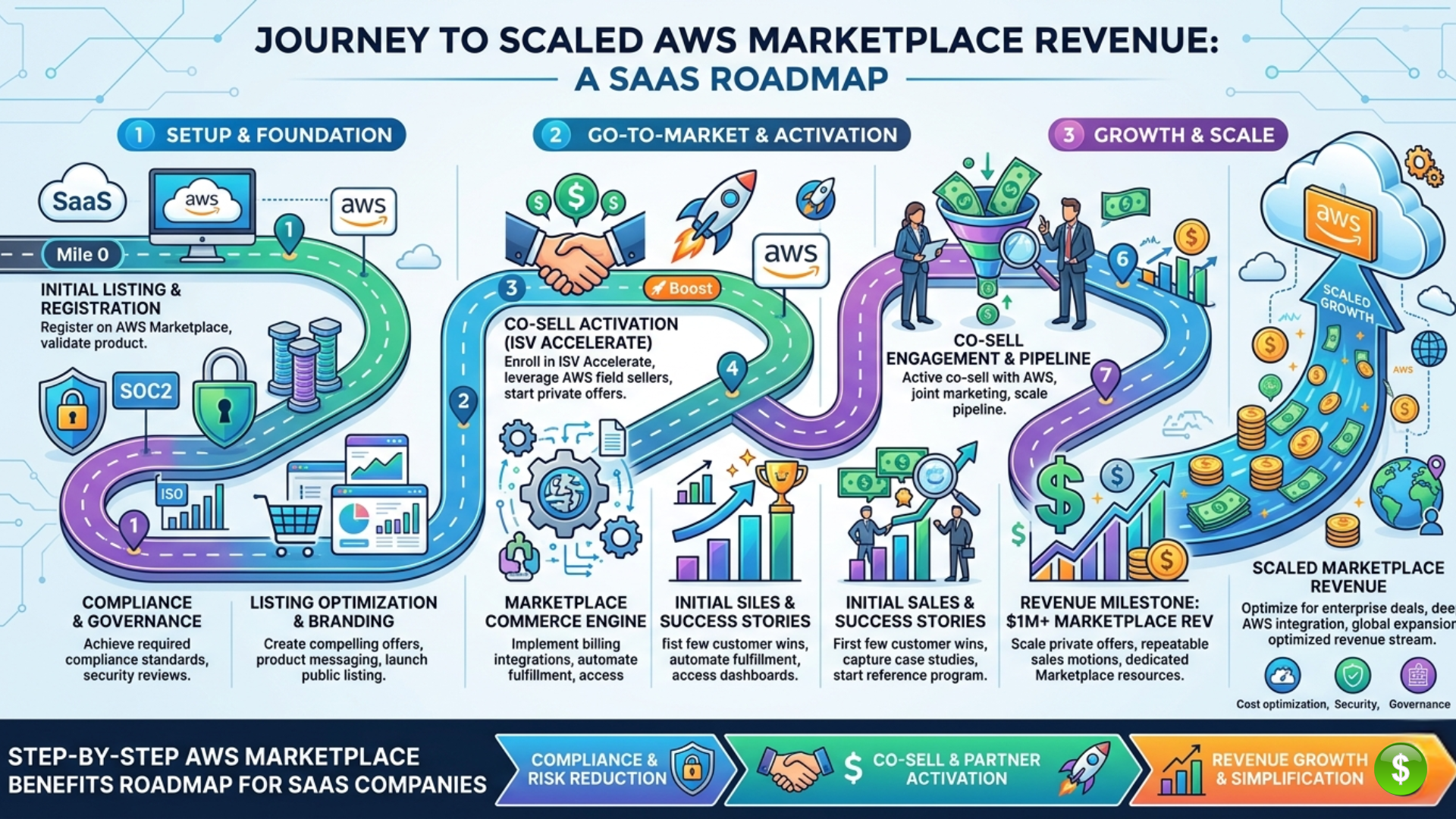
The most effective strategies combine Marketplace with existing motions. Use it for net-new acquisition via committed budgets, acceleration of stalled deals through Private Offers, and expansion of existing customers via renewals and add-ons.
Internal linking to complementary capabilities strengthens execution. For multi-cloud ambitions, teams often extend the same disciplined approach to Azure Marketplace. Platforms designed for growth-stage SaaS handle listings across clouds, automate Private Offers and approvals, maintain CRM alignment, and manage compliance and revenue operations in one interface. This allows your team to capture AWS marketplace benefits and equivalent advantages elsewhere without building separate teams or processes.
At Missioned.ai, we support exactly this integrated approach. Our platform simplifies multi-cloud marketplace management for growth-stage SaaS teams, from AI-powered listings to automated deal workflows and revenue reconciliation. Explore our list on cloud marketplaces and co-sell automation capabilities to accelerate your progress.
Measuring and optimising your Marketplace performance
Track these key metrics to quantify impact and drive continuous improvement:
- Marketplace-sourced pipeline percentage and conversion rates
- Average deal size and sales cycle length versus direct channels
- Co-sell engagement volume and win rates
- Revenue attribution accuracy and customer expansion through the channel
- Overall channel ROI and payback period
Mature programs often deliver compounding returns as listings gain visibility, co-sell relationships deepen, and operational maturity increases. Regular optimisation of product descriptions, pricing strategies, and co-sell playbooks maximises results.
FAQ
What are the primary AWS marketplace benefits for growth-stage SaaS companies?
Access to committed EDP budgets, 30-60% faster procurement cycles, co-sell incentives driving AWS seller engagement, reduced operational friction, larger deal sizes, and strong ROI typically ranging from 176% to 377% over three years.
How does AWS Marketplace help utilise committed cloud spend?
Transactions count toward buyer EDP and MACC commitments, allowing enterprises to draw from pre-allocated budgets and simplifying procurement approvals.
What role does co-sell play in AWS marketplace benefits?
ISV Accelerate and SaaS Co-Sell Benefit provide quota credit to AWS sellers, resulting in 51% higher revenue growth, faster closes, and larger deals for active partners.
Is AWS Marketplace suitable for early-stage or growth-stage SaaS teams?
Yes. The platform and supporting programs, including expanded benefits for startups, level the playing field by reducing complexity and providing access to enterprise budgets and field support.
How can teams reduce the operational burden of managing AWS Marketplace?
Dedicated platforms like Missioned.ai automate listings, Private Offers, CRM sync, compliance, and revenue operations, enabling focus on sales and product while capturing full channel benefits. See our marketplace revenue operations automation.
What metrics indicate a successful AWS Marketplace motion?
Strong indicators include shortened sales cycles, increased deal sizes, active co-sell pipeline contribution, accurate revenue recognition, and overall channel ROI exceeding traditional motions.
Ready to prioritise AWS Marketplace as a core revenue channel and capture committed budgets with reduced friction? Book a GTM session with the Missioned team. Our working session will evaluate your current setup, identify highest-impact opportunities, and outline a practical 90-day plan tailored to your growth stage. Book a GTM Session.