


.png)



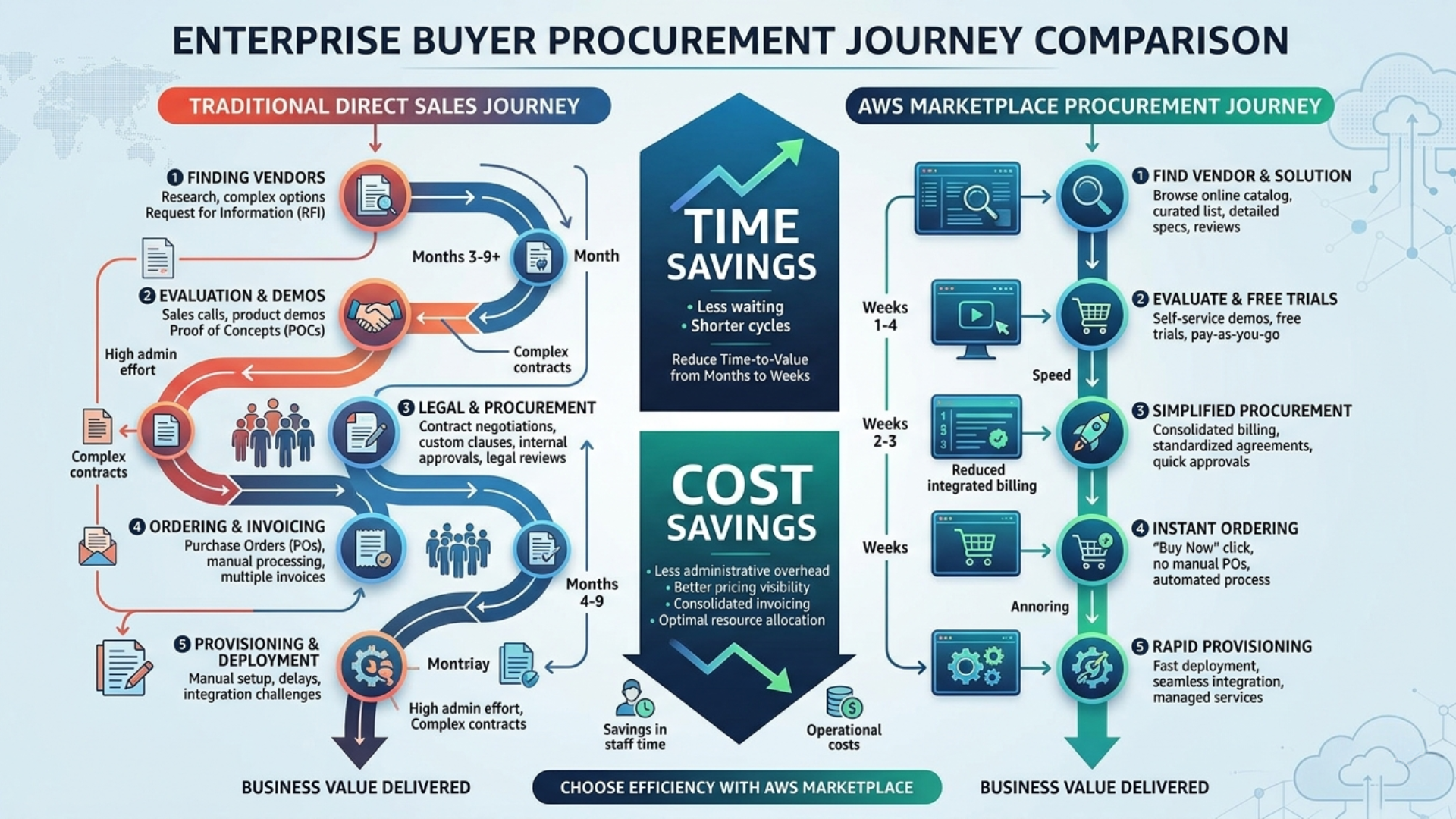
Enterprise buyers continue to allocate substantial committed budgets to their cloud providers. An optimized AWS Marketplace listing positions your SaaS solution directly where procurement happens, enabling buyers to use existing AWS spend while simplifying contracts and billing. For independent software vendors (ISVs), this channel delivers faster deal velocity, larger average deal sizes, and access to co-sell pipelines that traditional direct sales struggle to match.
In 2026, AWS Marketplace stands as a mature yet rapidly expanding revenue engine. Cloud marketplace software sales are projected to reach $163 billion globally by 2030, with AWS maintaining a dominant position. ISVs leveraging the platform effectively report significant uplifts: 40% faster sales cycles, 80% higher customer spend on third-party solutions, and win rates improving from 22% to 28% when transacting through Marketplace.
This practical, step-by-step guide walks through everything growth-stage SaaS teams need to launch successfully. It covers listing requirements, product types, pricing strategies, technical integrations, and the pitfalls that delay many ISVs. Throughout, we highlight how Missioned.ai streamlines the entire process so your team reaches revenue faster without operational overload.
Why prioritize an AWS Marketplace listing in 2026
Modern enterprises prefer purchasing third-party software through their primary cloud provider. This approach consolidates billing, leverages committed spend like MACCs, and reduces internal procurement friction. For sellers, the benefits compound quickly.
Recent data underscores the opportunity:
- ISV Accelerate Program participants saw 41% YoY increase in customer wins, 13% growth in Marketplace total contract value, and 16% rise in MPPO quantity in 2025.
- Co-sell motions deliver 51% higher revenue growth for engaged partners.
- Forrester’s Total Economic Impact study highlights 377% ROI over three years with payback in under six months for organizations using the Marketplace effectively.
Growth-stage SaaS companies using the channel often achieve their first Marketplace transaction within weeks rather than quarters, unlocking predictable revenue streams alongside direct sales.
Preparation: prerequisites before building your AWS Marketplace listing
Success starts with solid foundations. Skipping early steps often leads to approval delays or rework.
- Establish seller credentials
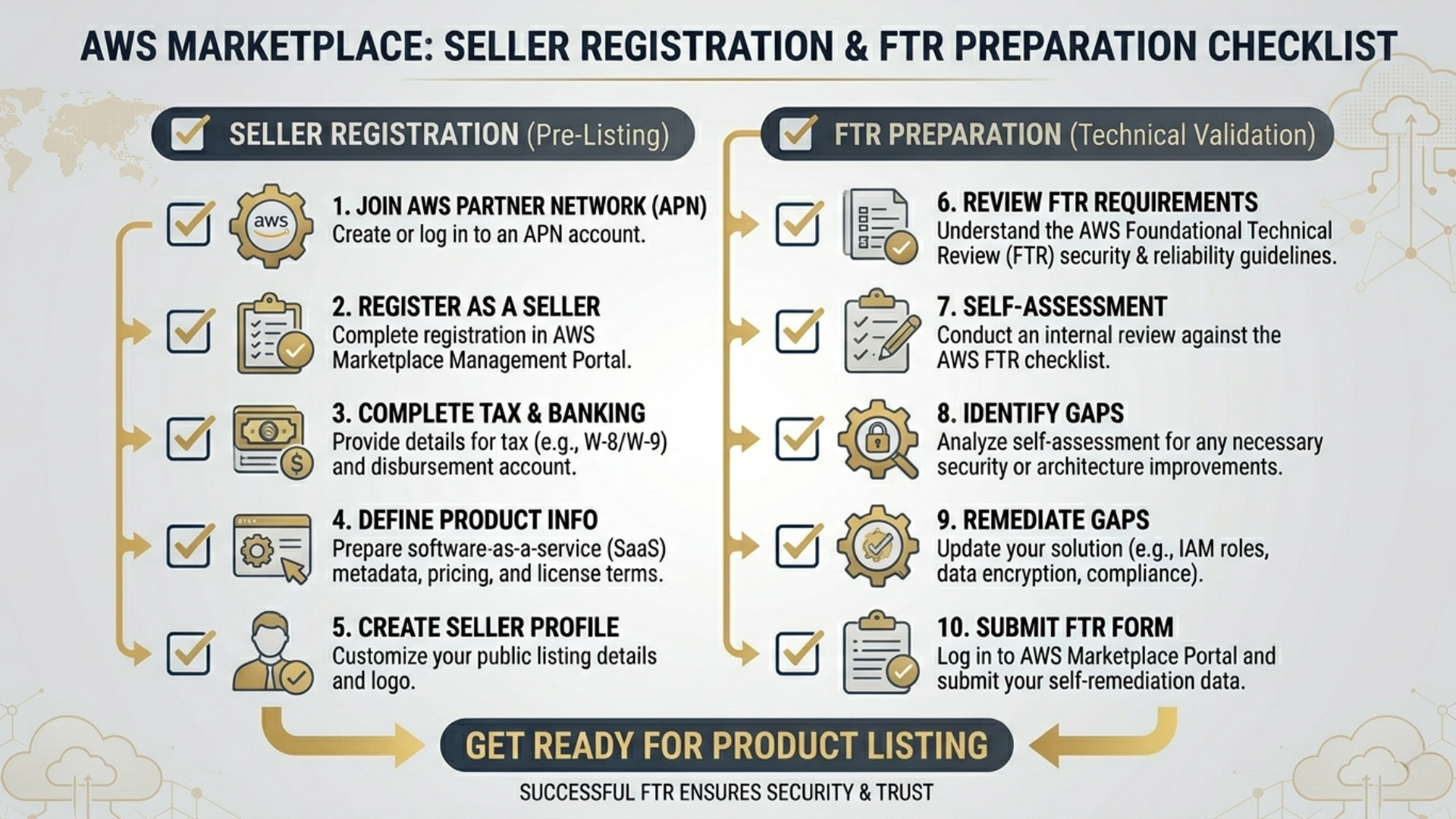
Register with an active business AWS account (avoid personal or root accounts). Complete AWS Partner Network (APN) enrollment and full seller registration in the AWS Marketplace Management Portal (AMMP). Submit tax forms (W-9/W-8BEN), banking details, and business verification documents. This process typically completes in days but requires accuracy to prevent disbursement issues later.
- Technical and compliance readiness
Prepare for the Foundational Technical Review (FTR), which evaluates security, reliability, performance, and operational excellence. Start this 6-8 weeks before target launch. Ensure your SaaS application supports dynamic provisioning and integrates with AWS APIs for entitlements and metering.
- Asset collection
Gather high-quality marketing materials: logo, screenshots, detailed descriptions, use cases, and an End User License Agreement (EULA) hosted on S3. Optimize content for discoverability with buyer-focused keywords and clear value propositions.
Choosing the right product type for your AWS Marketplace listing
AWS supports diverse delivery models. Selecting the appropriate type aligns your offering with buyer expectations and Marketplace visibility rules.
SaaS products (Recommended for most ISVs)
Fully hosted solutions managed by the seller. Customers subscribe without managing infrastructure. Supports contract, usage-based, or hybrid pricing. SaaS listings dominate for B2B applications due to ease of procurement and MACC eligibility.
AMI-based listings
Pre-configured machine images for EC2. Suitable for infrastructure tools requiring customer-managed deployments. Offers hourly, annual, or BYOL options.
Container products
Deploy via Amazon ECR or EKS. Ideal for cloud-native microservices. Requires robust Helm chart or container image management.
Other types
Data products, professional services, or machine learning algorithms serve specialized needs.
For growth-stage SaaS teams, begin with SaaS Contracts. This unlocks the broadest buyer appeal and integrates seamlessly with private offers and co-sell programs.
Detailed step-by-step process to create and launch your AWS Marketplace listing
Step 1: Seller registration and portal setup
Log into AMMP, complete profile, and verify all financial and tax information. Enable necessary IAM roles for Marketplace management.
Step 2: Product creation
Define product metadata: title, short and long descriptions, categories, keywords, support terms, and pricing dimensions. Focus on outcomes and integration points relevant to AWS users.
Step 3: Pricing configuration
Select models that match usage patterns. Define dimensions (e.g., users, API calls, storage). Public listings carry a standard 3% fee, while private offers benefit from tiered reductions.
Step 4: Technical integration
Implement fulfillment URLs, SNS notifications for subscription events, and metering if usage-based. Test thoroughly in sandbox environments.
Step 5: Review and submission
Submit for AWS review (typically 3-7 business days). Address feedback on security, documentation, or integration completeness.
Step 6: Go Live and monitor
Launch publicly or via targeted private offers. Track performance metrics and iterate on listing content.
Step 7: Post-launch optimization
Update assets regularly, enable trials, and activate co-sell to drive referrals.
Mastering pricing models to maximize revenue on AWS Marketplace
Flexible pricing drives adoption. Key options include:
- Contract pricing: Monthly or annual commitments for budget predictability. Popular for enterprise deals.
- Usage-based (metered): Aligns cost with consumption. Requires hourly metering via AWS APIs.
- Hybrid models: Base subscription plus variable usage charges.
- Private offers: Custom terms, discounts, and schedules, often representing 65-75% of high-value revenue for mature ISVs.
- Free trials and promotions: Reduce buyer risk and accelerate evaluation.
Concurrent Agreements support (mandatory for new listings post-June 2026) allows multiple active purchases under one AWS account, improving flexibility.
Implementing metering: the technical backbone of usage-based listings
Usage-based pricing demands reliable integration with the AWS Marketplace Metering Service. Your application must report consumption hourly using BatchMeterUsage API calls.
Best practices
- Report per dimension, per customer, per hour.
- Implement retries with exponential backoff for resilience.
- Align dimensions precisely with pricing to avoid billing disputes.
- Test edge cases like outages or spikes.
Many ISVs underestimate this step. Missioned handles metering setup and validation, reducing engineering burden significantly.
Common mistakes ISVs make with AWS Marketplace listings
Even capable teams encounter setbacks. Avoid these frequent issues:
- Using personal or root AWS accounts: Violates best practices and complicates scaling.
- Incomplete metering or entitlement logic: Leads to rejected submissions or customer billing complaints.
- Generic listing content: Fails to differentiate or rank well in search.
- Delaying FTR or compliance work: Extends timelines by weeks.
- Neglecting private offer strategy: Misses the bulk of enterprise revenue.
- Lack of post-launch governance: Listings become stale without ongoing optimization.
- Poor CRM and revenue attribution: Creates data silos and manual reconciliation work.
These mistakes often turn a potential quick win into months of friction. Dedicated platforms mitigate them effectively.
How Missioned simplifies AWS Marketplace listing and scales revenue operations
Missioned.ai delivers a unified platform purpose-built for growth-stage SaaS teams. Instead of fragmented tools and manual processes, you gain:
- AI-powered listing management: Generate and optimize content tailored to AWS ranking algorithms across marketplaces.
- End-to-end private offer automation: Create, approve, and track deals via email without repeated portal access.
- Bidirectional CRM integration: Sync pipeline data with Salesforce, HubSpot, and others in real time.
- Compliance automation: Navigate FTR, ISV Accelerate, and technical reviews with guided workflows.
- Revenue operations excellence: Accurate metering support, attribution, pre-billing validation, and multi-account handling.
Teams using Missioned launch faster, reduce operational overhead, and focus sales efforts on high-value activities. Learn more about how to List on Cloud Marketplaces and Marketplace Revenue Operations Automation capabilities.
Measuring and scaling success after your AWS Marketplace listing goes live
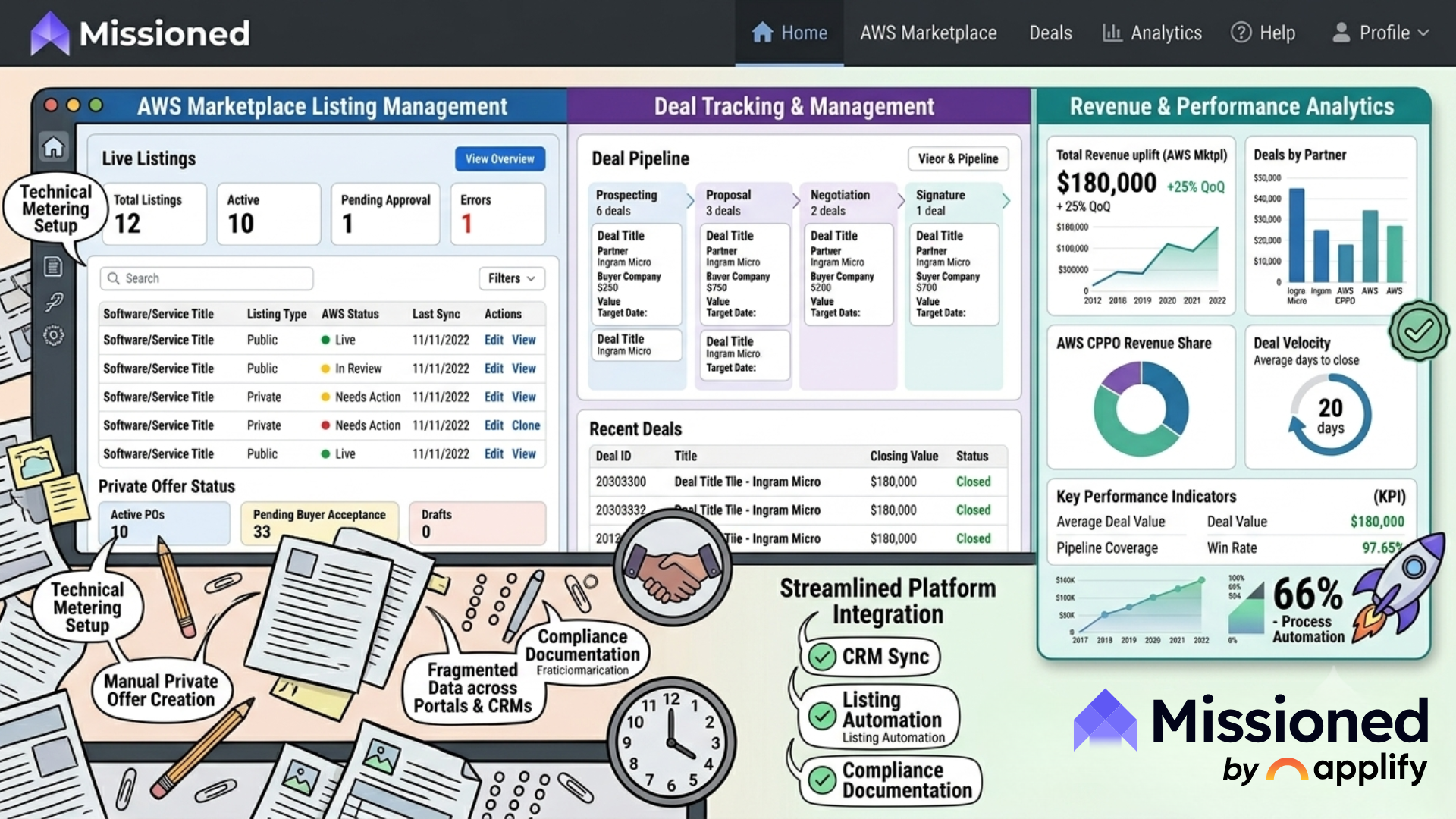
Post-launch metrics matter most. Monitor listing impressions, conversion rates, influenced pipeline, deal velocity, and attributed revenue. Leverage co-sell referrals through ISV Accelerate for amplified reach.
Missioned’s tools provide clear visibility and automated reconciliation, ensuring you capture full value from the channel.
Frequently Asked Questions
How long does it take to launch an AWS Marketplace listing in 2026?
Typically 4-8 weeks for well-prepared SaaS products. Missioned can accelerate this by managing technical and compliance elements.
Is metering integration mandatory?
Required for usage-based pricing. Contract-only models have lighter requirements, but hybrid approaches often deliver best results.
What fees does AWS charge for listings?
Around 3% for public SaaS transactions, with lower rates for larger private offers. No upfront costs for listing.
Can I list on AWS and Azure simultaneously?
Absolutely. Unified platforms like Missioned make multi-cloud management efficient without duplicating effort.
How critical are Private Offers for revenue?
Essential, they often drive the majority of enterprise volume with custom terms and faster procurement.
What ongoing support does AWS provide?
Access to partner programs, marketing resources, co-sell opportunities, and seller portal guidance.
Turn your AWS Marketplace listing into a predictable revenue channel
An effective AWS Marketplace listing represents more than a product page. When executed with operational excellence, it becomes a scalable engine that captures committed cloud budgets and accelerates overall growth.
Growth-stage teams no longer need to navigate complexity alone. Missioned handles the heavy lifting so you reach revenue faster and operate more efficiently.
Ready to move forward? Book a GTM Session with our team. In this collaborative working session, we assess your current setup, identify quick wins on AWS Marketplace, and outline a clear 90-day plan tailored to your stage.
Book a GTM Session today or start with our free Readiness Assessment.
Don’t let committed budgets flow to competitors. Let Missioned help you build a thriving cloud marketplace motion.