






Enterprise buyers route more software purchases through committed cloud budgets on AWS Marketplace every quarter. For growth-stage SaaS companies, a strong marketplace presence unlocks access to that spend without the friction of traditional procurement. Yet many teams delay entry because the seller process appears complex, compliance-intensive, and resource-heavy.
This updated 2026 AWS Marketplace seller guide delivers a clear, step-by-step walkthrough. You will learn seller eligibility, the full registration process, offer types, pricing models, disbursements, ongoing responsibilities, and common pitfalls to avoid. By the end, you will have a practical roadmap plus insight into how purpose-built platforms transform this channel into a scalable, predictable revenue stream.
Marketplace momentum continues to accelerate. Enterprise software sales through cloud marketplaces reached about 30 billion dollars in 2024 and are forecast to reach 163 billion dollars by 2030, expanding at a 29.1 percent compound annual growth rate. Agentic AI categories alone could contribute an additional 24.4 billion dollars. Sellers who operationalize the channel effectively often achieve 41 percent faster business growth compared to their overall software revenue.
Missioned streamlines the entire seller journey for growth-stage SaaS teams. The platform automates listings across AWS and Azure, private offers, compliance, CRM synchronization, co-sell pipelines, and revenue operations so your sales and product teams stay focused on closing deals rather than managing portals and spreadsheets.
Why AWS Marketplace remains a strategic priority for SaaS companies
AWS Marketplace operates as a curated digital storefront where buyers discover, evaluate, purchase, and deploy third-party solutions directly against their existing AWS commitments. This model eliminates many procurement hurdles: separate vendor approvals, new invoicing processes, and lengthy legal negotiations become far simpler in many cases.
Buyers benefit from consolidated billing, faster deployment, and confidence that solutions meet AWS standards. Sellers gain access to committed enterprise budgets (including Enterprise Discount Programs), visibility to AWS field sales teams through co-sell programs such as ISV Accelerate, and streamlined global distribution.
For growth-stage companies, the upside is substantial. Forrester’s Total Economic Impact study of AWS Marketplace highlights a 377 percent average three-year ROI with payback typically within six months for organizations leveraging the channel effectively. Additional benefits include 70 percent faster solution discovery for buyers and notable improvements in deal velocity and renewal rates.
Success, however, demands more than publishing a listing. It requires disciplined execution across registration, product configuration, offer management, metering integration (for usage-based models), and continuous optimization. Teams that treat the marketplace as a core GTM motion consistently outperform those that approach it opportunistically.
Seller eligibility requirements: Confirm you qualify before investing time
AWS maintains clear eligibility criteria that vary depending on whether you offer free or paid products and the regions where you intend to sell.
General requirements applicable to all sellers
- An active AWS account in good standing
- Publicly available, production-ready software with documented customer support processes
- A defined mechanism for regular updates and vulnerability remediation
- Full adherence to AWS Marketplace seller terms and conditions
Additional requirements for paid products
- Legal entity status or permanent residency in an eligible jurisdiction (AWS maintains and updates this list regularly; always verify current status)
- Accurate tax documentation (W-9 for US entities, W-8 series for international)
- A verified US bank account for disbursements (or supported alternatives such as Hyperwallet for certain international setups)
- Completion of Know Your Customer (KYC) verification where required, particularly for EMEA and select APAC sales
- Bank account validation to enable payouts
Best practice recommendation: Use a dedicated “seller of record” AWS account separate from production environments. This separation enhances security, simplifies compliance audits, and limits access appropriately. Apply least-privilege IAM policies and avoid heavy root user activity.
If your organization falls outside eligible jurisdictions for paid listings, free or BYOL options may still be viable, but revenue potential remains constrained. Review the latest official seller guide and confirm your tax and billing console settings match exactly.
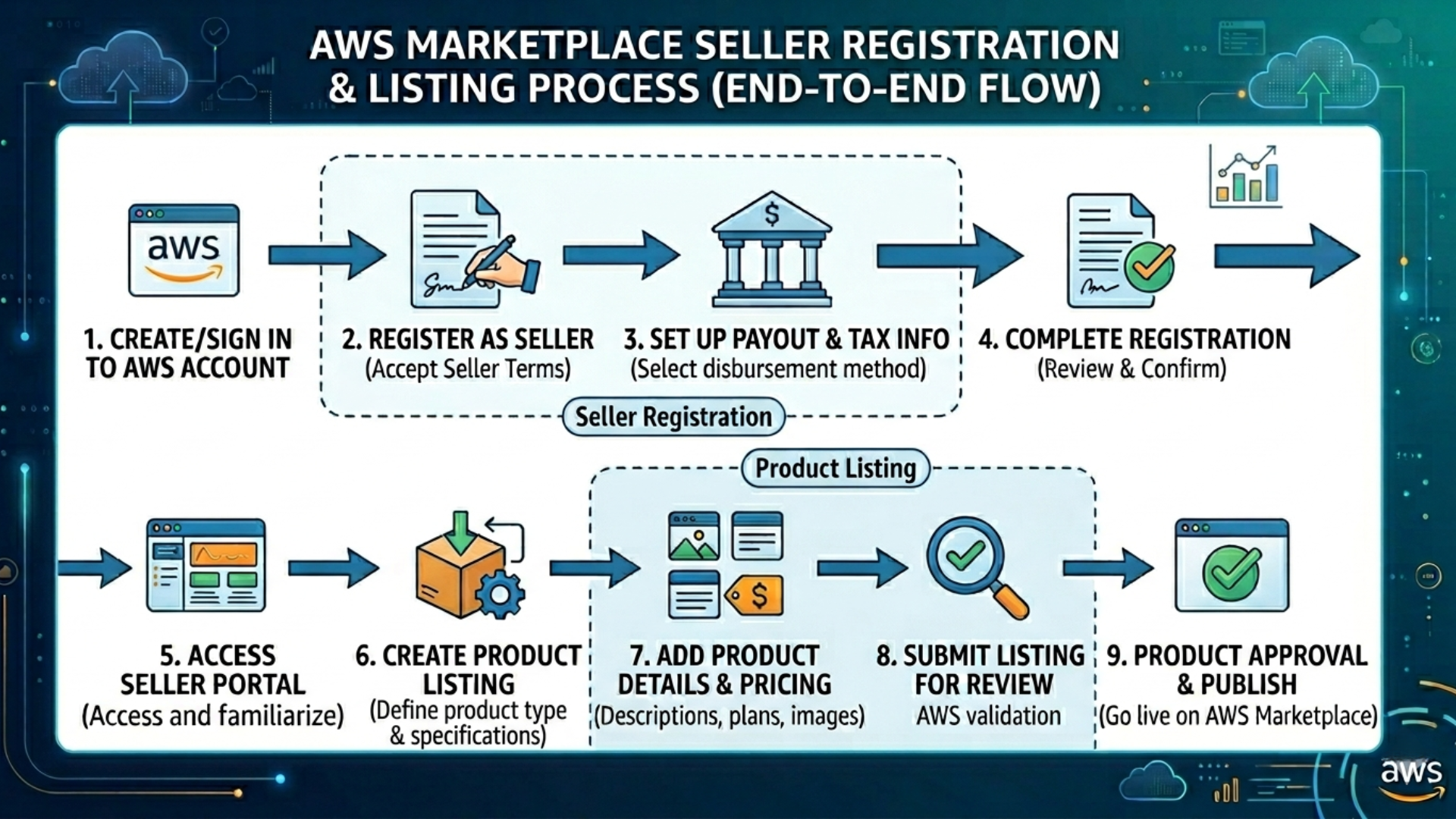
The seller registration process: Step-by-step with practical tips
Registration occurs primarily through the AWS Marketplace Management Portal (AMMP). With proper preparation, most teams complete core steps within days, although KYC and banking verification can extend timelines.
Detailed registration steps
- Prepare your public seller profile: Include legal entity name, display name, company website, professional description, and high-quality logo (SVG or PNG, transparent background, maximum 500 KB, sized appropriately for display).
- Complete tax information: Execute the tax interview process. Ensure the jurisdiction in your AWS Billing console exactly matches the tax details provided. US entities submit W-9; international sellers provide W-8 and relevant VAT/GST numbers.
- Set up banking and disbursement preferences: Supply US bank details early. Configure payout schedules (daily, weekly, or monthly) and minimum thresholds to align with your cash flow needs.
- Complete KYC verification: Required for many regions. You can designate secondary users to assist with documentation.
- Review and accept all agreements: Including seller terms and any supplemental tax registrations.
- Enroll in optional services: Such as the AWS Marketplace Tax Calculation Service for automated compliance handling.
Industrial insight and common pitfalls
Many teams begin product configuration before finishing banking and tax setup, causing unnecessary delays. Using personal accounts or root credentials instead of dedicated IAM roles creates security and audit risks. Gathering all documentation upfront (company records, tax forms, bank verification letters, support SLAs) accelerates approval.
Once registered, you unlock the full seller toolkit, including analytics dashboards, private offer management, and integration options for metering and CRM.
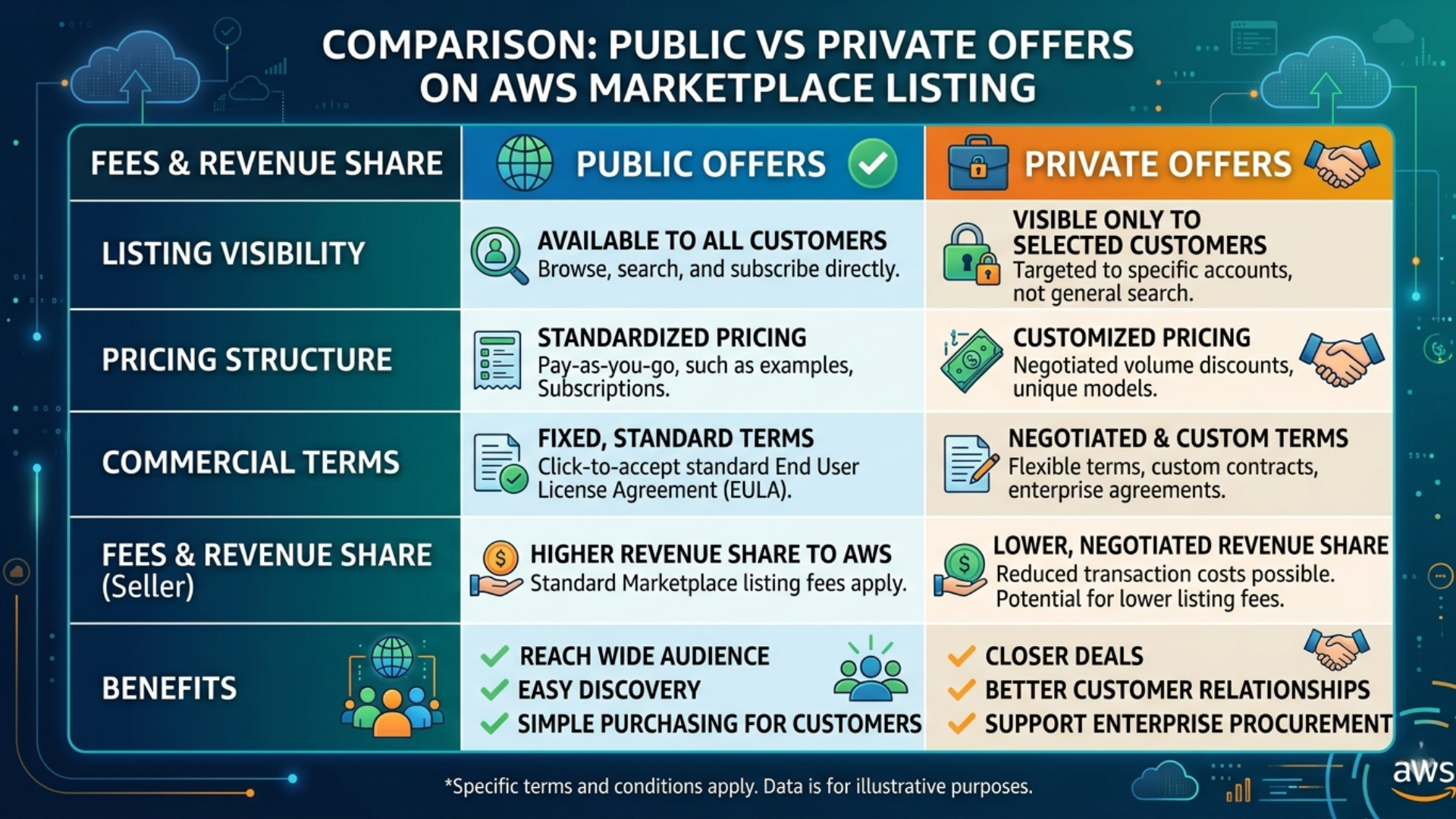
Offer types, pricing models, and strategic considerations
AWS supports flexible offer structures that align with different sales motions.
Public offers drive broad discoverability in the catalog and suit self-service buyers. Standard SaaS fees typically sit at 3 percent.
Private offers power the majority of enterprise revenue. They enable negotiated pricing, custom terms (1–36 months), and tiered fees that improve with scale: 3 percent under 1 million dollars total contract value, 2 percent between 1–10 million dollars, and 1.5 percent at 10 million dollars or above. Renewals often qualify for the 1.5 percent rate. These offers also enhance co-sell eligibility.
Supported pricing models include:
- Subscription (monthly or annual)
- Usage-based metering via AWS Marketplace Metering Service
- Contract-based
- Hybrid (base fee plus consumption)
- Bring Your Own License (BYOL)
Note that the core pricing model selected for a product listing is generally fixed after publication. Plan your GTM strategy thoughtfully. Usage-based models require robust metering integration with hourly reporting best practices, retry logic, and batch handling to avoid lost revenue.
Channel Partner Private Offers (CPPO) introduce an additional 0.5 percent fee uplift but expand partner-driven sales.
How disbursements work and revenue reconciliation best practices
AWS handles buyer billing and disburses net proceeds to your configured US bank account according to your chosen schedule. Payouts typically process monthly between the 7th and 10th, though you can optimize frequency and thresholds for cash flow.
Reports from AWS Commerce Analytics Service provide transaction visibility, but full reconciliation involves matching marketplace data against internal records, especially for metered usage, partial refunds, credits, and multi-region taxes. Early-stage teams should model the initial 30–60 day cycle carefully.
Key best practices
- Align disbursement frequency with operational needs
- Set thresholds high enough to minimize wire fees for international flows
- Implement automated tagging and user-agent tracking for accurate attribution
- Validate pre-billing data to reduce disputes
Without dedicated operations support, reconciliation can become a significant time sink as volume grows.
Ongoing seller responsibilities and optimization strategies
A successful listing is the starting point, not the finish line. Top-performing sellers maintain active management across several areas:
- Regular updates to product descriptions, screenshots, architecture diagrams, and marketing assets
- Proactive monitoring of buyer inquiries and support tickets
- Version management, security patches, and feature announcements
- Listing optimization using targeted keywords, categories, and search engine best practices
- Performance tracking via analytics and adjustment of offers or pricing
- Active participation in co-sell programs through ACE for referral pipeline
- Professional handling of upgrades, renewals, and refund requests
- Staying current with policy changes and regional compliance
Teams that refresh content quarterly and review analytics monthly see better visibility and higher field-sales confidence. Treating the marketplace as a living channel rather than a one-time project drives compounding returns.
Common mistakes include outdated listings, incomplete metering implementation, poor CRM alignment, and neglecting partner program enrollment. These issues limit discoverability and create operational drag.
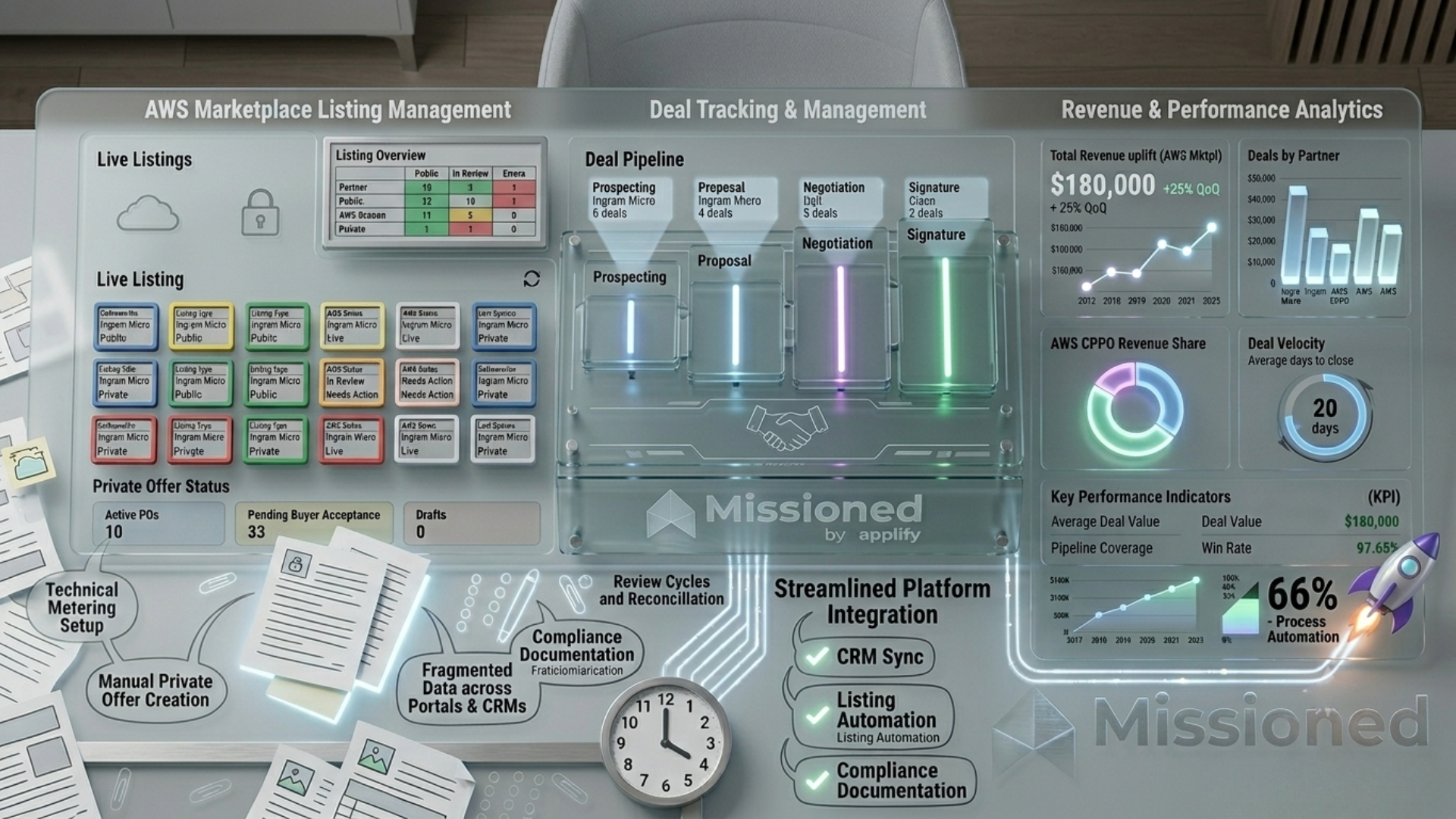
How Missioned simplifies and accelerates the full seller journey
Manual execution works for some, but growth-stage SaaS teams quickly encounter friction across multiple clouds, portals, and systems. Missioned addresses this by delivering a unified automation layer that covers:
- AI-powered, marketplace-optimized listing creation and management across AWS and Azure
- Email-based private offer approvals and workflow management without constant portal access
- Automated compliance documentation and technical reviews for partner programs
- Bidirectional synchronization with major CRMs including Salesforce, HubSpot, and others
- Co-sell pipeline management, referral tracking, and ISV Accelerate support
- End-to-end revenue operations, metering validation, tagging, and disbursement reconciliation
Customers typically move from initial setup to consistent pipeline generation in weeks rather than quarters. By removing operational bottlenecks, Missioned lets your team capture committed cloud budgets more effectively while scaling without proportional headcount growth.
Frequently asked questions
What are the primary requirements to become an AWS Marketplace seller?
You need an AWS account in good standing, production-ready software, defined support processes, and for paid products, proper tax documentation, a US bank account, eligible jurisdiction status, and KYC completion where applicable.
How long does the AWS Marketplace seller registration typically take?
Core registration can finish in a few days with preparation, but banking verification and KYC often add one to several weeks. Starting with all documents ready shortens the timeline significantly.
What fees does AWS charge on Marketplace transactions?
Public SaaS offers usually carry a 3 percent fee. Private offers benefit from tiered rates (3 percent under 1 million dollars TCV, 2 percent up to 10 million dollars, 1.5 percent above), with renewals often at 1.5 percent. Confirm current rates in official documentation.
How do disbursements and payouts function?
AWS collects from buyers and disburses net amounts to your bank on your selected schedule. Monthly payouts are standard, with detailed reports supporting reconciliation. Automation helps manage accuracy at scale.
Can growth-stage SaaS companies realistically succeed on AWS Marketplace?
Yes. The channel equalizes access to enterprise budgets and co-sell support. With the right operational foundation and automation like Missioned, smaller teams achieve meaningful revenue without large dedicated marketplace staff.
What distinguishes public offers from private offers?
Public offers support broad catalog visibility and self-service purchases. Private offers enable negotiated enterprise deals with custom terms, improved economics, and stronger alignment with AWS sales teams.
Ready to launch or scale your AWS Marketplace presence?
The opportunity in cloud marketplaces is substantial and growing rapidly, but disciplined execution separates high-performing sellers from the rest. Whether you are preparing your first listing or optimizing an existing one, combining deep process knowledge with intelligent automation produces the fastest results.
Book a GTM session with the Missioned team. We will analyze your current setup, outline a tailored Marketplace plan, and demonstrate exactly how our platform removes friction so you can capture more revenue through cloud channels.