






Enterprises today commit massive budgets to cloud providers through Enterprise Discount Programs and similar agreements. Yet without structured controls, this spend risks inefficiency, compliance issues, and shadow IT. A private marketplace solves this by creating a governed, internal catalog of pre-approved solutions from public cloud marketplaces.
A private marketplace is an organization-specific, curated version of AWS Marketplace (or equivalent on other clouds) where administrators define exactly which third-party software, data, and services employees can discover and purchase. It combines the speed and simplicity of marketplace buying with enterprise-grade policy enforcement.
For growth-stage SaaS companies, securing placement and excelling in these private environments has become a critical revenue channel. It unlocks committed budgets, shortens procurement cycles, and positions your product as a trusted, approved solution.
This guide explains the concept in detail, explores real-world usage, and shows how platforms like Missioned help ISVs thrive within these ecosystems.
The core concept of private marketplaces in cloud procurement
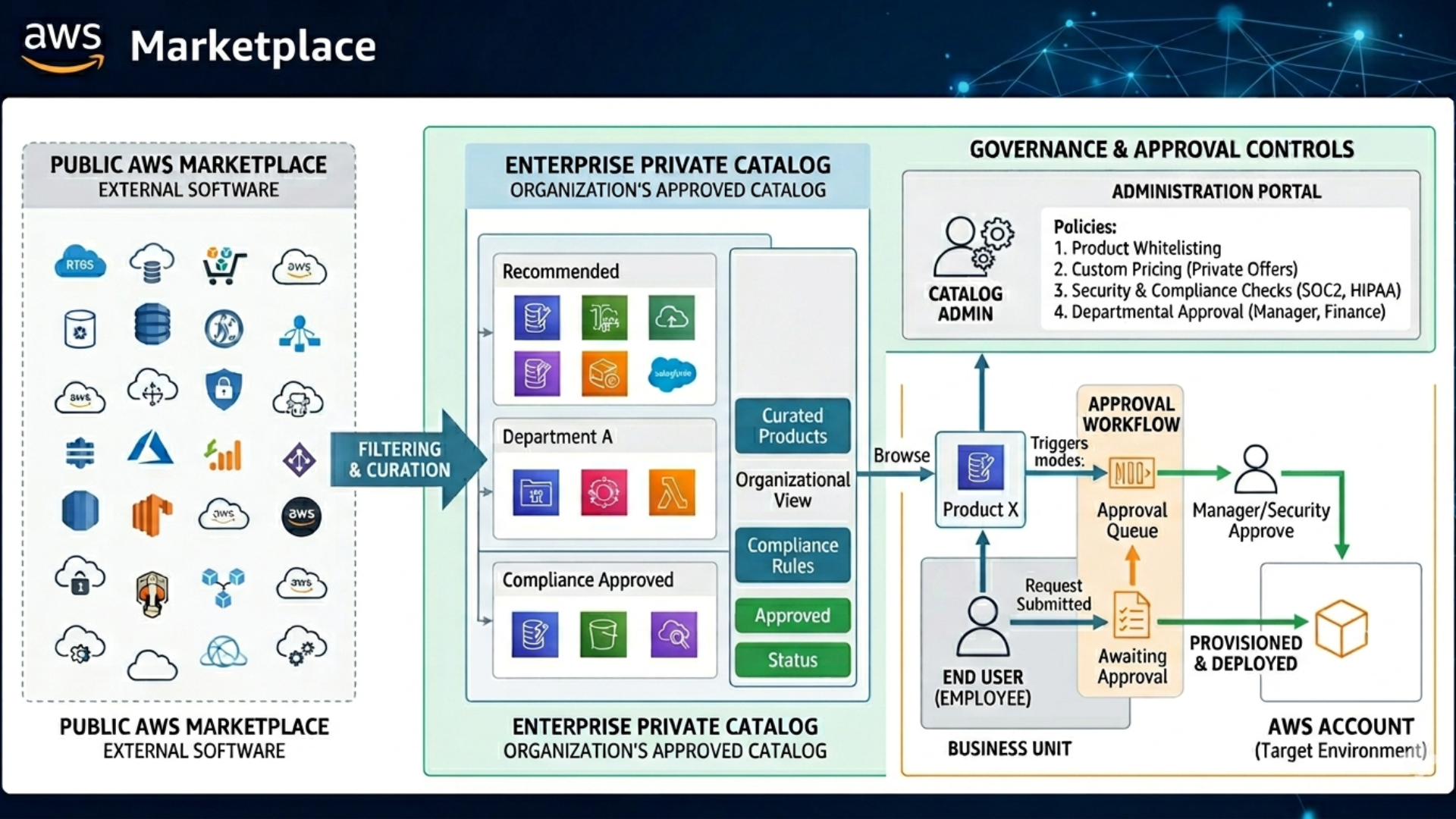
At its foundation, a private marketplace acts as a filtered storefront. Public marketplaces like AWS Marketplace offer thousands of listings. A private marketplace narrows this to only those vetted by the enterprise’s procurement, security, and finance teams.
On AWS, this feature is called Private Marketplace. Administrators create one or more customized experiences, branded catalogs with company logos, messaging, and tailored product selections. These experiences can be assigned to specific organizational units (OUs), accounts, or user groups within AWS Organizations for granular control.
Users logging into AWS Marketplace are automatically redirected to their assigned private experience, where only approved products appear. This default-deny approach ensures governance without blocking innovation. Recent enhancements include improved bulk approval tools and multi-experience management wizards, making it practical even for complex global organizations.
Purchases through a private marketplace still draw directly from the buyer’s AWS bill and count toward committed spend targets, providing a seamless experience that aligns technical agility with financial and compliance priorities.
Why enterprises adopt private marketplaces for cloud spend control
Modern enterprise cloud procurement faces persistent challenges. Teams adopt new tools rapidly, often outside approved channels. Security and legal reviews create bottlenecks. Meanwhile, large portions of negotiated cloud commitments go unspent.
Private marketplaces address these pain points directly:
- Governance without friction: Procurement teams enforce standards while enabling self-service for approved solutions.
- Spend optimization: Marketplace transactions help retire committed spend, maximizing the value of Enterprise Discount Programs.
- Risk reduction: Pre-vetted listings inherit cloud provider compliance baselines, reducing internal review overhead.
Industry data underscores the impact. Flexera’s 2025 State of the Cloud Report indicates organizations waste an average of 28% of cloud spend. Private marketplaces help recapture this by channeling purchases through controlled, efficient paths.
Forrester’s Total Economic Impact studies on cloud marketplaces consistently show strong returns, including 377% average three-year ROI for organizations leveraging AWS Marketplace effectively. Procurement cycles that once took 60-120 days shrink to 14-30 days.
Step-by-step: How enterprises build and operate a private marketplace
Setting up and running a private marketplace follows a repeatable process that balances control with usability:
- Policy alignment: Cross-functional teams (procurement, security, finance, cloud center of excellence) define approval criteria, including security certifications, pricing transparency, integration capabilities, and business value.
- Experience creation: Administrators use the AWS Marketplace console to build branded catalogs. They customize logos, colors, and messaging to reinforce internal standards.
- Product curation: Teams review and approve listings in bulk. Approved products become visible to targeted users or accounts.
- Access and enforcement: Experiences link to AWS Organizations for automatic redirection. Role-based controls (administrator, subscription manager, end user) add further precision.
- Ongoing management and monitoring: Catalogs evolve with business needs. Cost allocation tags, reporting dashboards, and usage analytics provide visibility into adoption and spend patterns.
This structured approach delivers both control and speed. For instance, a financial services firm might restrict certain business units to highly regulated tools while giving engineering broader access to DevOps solutions.
Key benefits for enterprise buyers
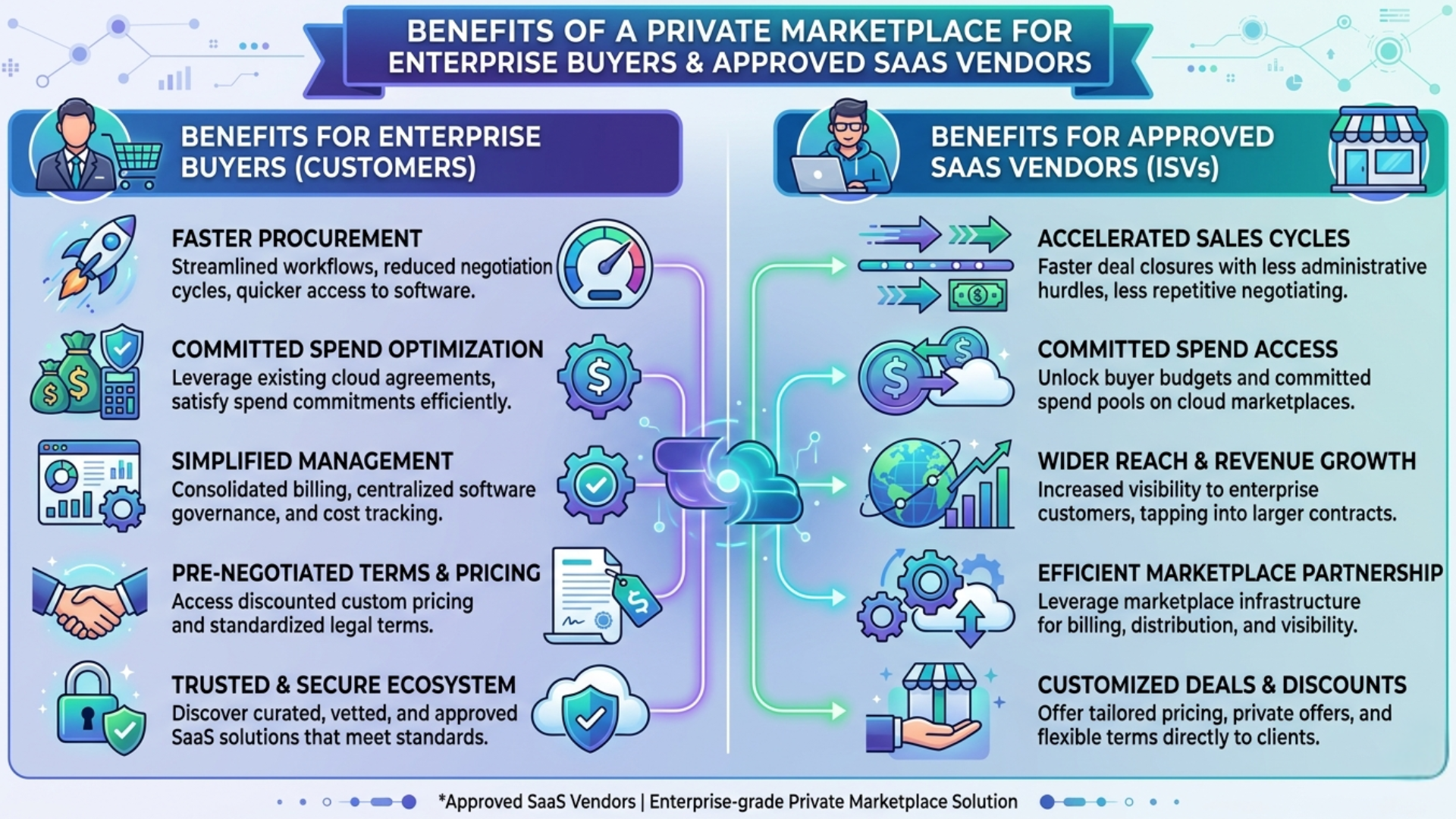
Enterprise adopters realize tangible advantages:
- Accelerated time-to-value: Pre-approved solutions deploy in minutes rather than months.
- Cost efficiency: Spend counts against existing commitments, helping meet EDP targets and unlocking volume discounts.
- Simplified compliance: Marketplace listings carry baseline certifications. This reduces redundant security assessments.
- Improved visibility: Consolidated billing and automatic tagging support mature FinOps practices.
- Innovation enablement: Teams access vetted tools quickly, boosting productivity without procurement delays.
Real outcomes include 50% reductions in procurement effort and significant recapture of at-risk committed spend, according to marketplace analyses.
Advantages for ISVs and SaaS vendors listed in private marketplaces
For sellers, inclusion in customer private marketplaces is transformative. Approved products gain prominent placement inside the environments where buyers actively shop for governed solutions.
This drives:
- Higher discoverability and trust signals.
- Faster deal velocity through reduced friction.
- Larger average deal sizes, as private offers become the natural vehicle for negotiation.
- Better alignment with buyer incentives to maximize committed spend.
Private offers already account for 65-75% of AWS Marketplace revenue for mature ISVs. Placement in private catalogs amplifies this further by positioning your solution as procurement-ready.
The role of private offers within private marketplaces
While public listings support self-service, enterprise-scale deals rely on private offers, custom pricing, terms, and entitlements shared with specific buyers.
Buyers often discover solutions in their private marketplace and then request or receive private offers for negotiated discounts, flexible schedules, and custom contracts. This combination of governance (private catalog) and flexibility (private offers) is powerful.
However, managing private offers across consoles, tracking statuses, and syncing to CRM creates operational burden for ISVs.
Missioned’s private offers management changes this. Create, send, track, and close deals from a single inbox with email-based approvals and automatic CRM synchronization. No more portal hopping or manual updates. This capability directly supports faster responses to enterprise buyers operating within private marketplaces. Learn more about private offers management.
Best practices for SaaS companies to succeed in private marketplaces
Winning and maintaining traction requires deliberate effort:
- Optimize public listings: Ensure clear value propositions, prominent compliance details, transparent pricing, and strong ROI evidence. AI-assisted content helps tailor descriptions to marketplace ranking algorithms.
- Support seamless private offers: Enable flexible terms that align with buyer needs.
- Engage co-sell programs: Participation in AWS ISV Accelerate or similar initiatives increases visibility and warm referrals.
- Streamline operations: Use platforms that automate compliance documentation, listing management, and revenue reconciliation.
Missioned supports the full journey, from AI-powered listings across AWS and Azure to compliance automation and revenue operations, so your team focuses on growth. Explore listing on cloud marketplaces.
Challenges and how to overcome them
Common hurdles include initial catalog setup requiring cross-team alignment and ongoing maintenance as needs evolve. For sellers, high volumes of private offer requests can strain resources without proper tooling.
Modern platforms address these by centralizing workflows, providing audit trails, and automating repetitive tasks. Enterprises benefit from scalable administration features, while ISVs gain operational leverage.
Future outlook for private marketplaces
As cloud adoption matures, private marketplaces will likely incorporate more AI-driven recommendations, enhanced analytics, and tighter integration with enterprise procurement systems. With committed spend growing and governance demands increasing, these controlled environments represent a stable, high-potential channel for SaaS revenue.
Common questions about private marketplaces
What is the difference between AWS Marketplace and a private marketplace?
AWS Marketplace is the broad public catalog. A private marketplace is a customer-controlled subset with custom branding, approvals, and access restrictions.
Who typically manages private marketplaces inside enterprises?
A cross-functional team including procurement, cloud platform engineers, security, and finance. AWS supports delegated administration for scalability.
Do purchases through private marketplaces count toward committed cloud spend?
Yes. They contribute to Enterprise Discount Program targets and similar commitments, helping enterprises maximize negotiated agreements.
How do private offers integrate with private marketplaces?
Buyers discover approved products in the private catalog and negotiate custom terms via private offers, combining policy compliance with deal flexibility.
Can ISVs directly influence placement in customer private marketplaces?
Indirectly, through compelling listings, strong compliance posture, responsive private offer processes, and successful co-sell engagements. Operational excellence with tools like Missioned helps scale this.
What are the main implementation challenges?
Cross-team coordination for initial policies and ongoing catalog updates. Both buyers and sellers benefit from platforms that reduce manual effort.
Ready to win in enterprise private marketplaces?
Private marketplaces have redefined cloud software procurement, delivering governance, speed, and spend efficiency in one cohesive experience. For SaaS teams, mastering this channel means accessing committed budgets and closing larger deals faster.
Missioned was purpose-built for growth-stage companies navigating this landscape. Our platform handles listings, private offers, compliance, CRM integration, co-sell automation, and revenue operations end-to-end, turning cloud marketplaces into a predictable revenue engine.
Book a GTM Session today to explore how Missioned can help your product thrive inside enterprise private marketplaces and accelerate your cloud GTM motion.