


.png)



What is AWS marketplace?
If you are a SaaS founder or ISV leader evaluating new revenue channels, you have likely asked: what is AWS Marketplace? In simple terms, it is Amazon Web Services’ digital storefront where enterprises discover, purchase, and deploy third-party software directly within their AWS environment. Launched in 2012, it has evolved into the largest cloud marketplace, connecting thousands of independent software vendors with over 330,000 active buyers.
Buyers spend committed cloud budgets on solutions that integrate seamlessly, while sellers gain access to pre-approved procurement paths, faster deal cycles, and co-sell support from AWS teams. For growth-stage SaaS companies, this is not just another sales channel. It is a way to capture enterprise spend that buyers are already obligated to use.
In 2026, AWS Marketplace continues to drive significant growth. Forrester’s Total Economic Impact study highlights 70 percent time savings in product discovery and 60 percent in procurement for buyers, alongside faster time-to-market. Major ISVs like Salesforce have surpassed $5 billion in cumulative Marketplace transactions, while others report multi-billion-dollar runs.
This guide explains exactly how AWS Marketplace operates, who benefits most, and how platforms like Missioned help ISVs simplify operations to focus on growth.
How AWS Marketplace works for buyers and sellers
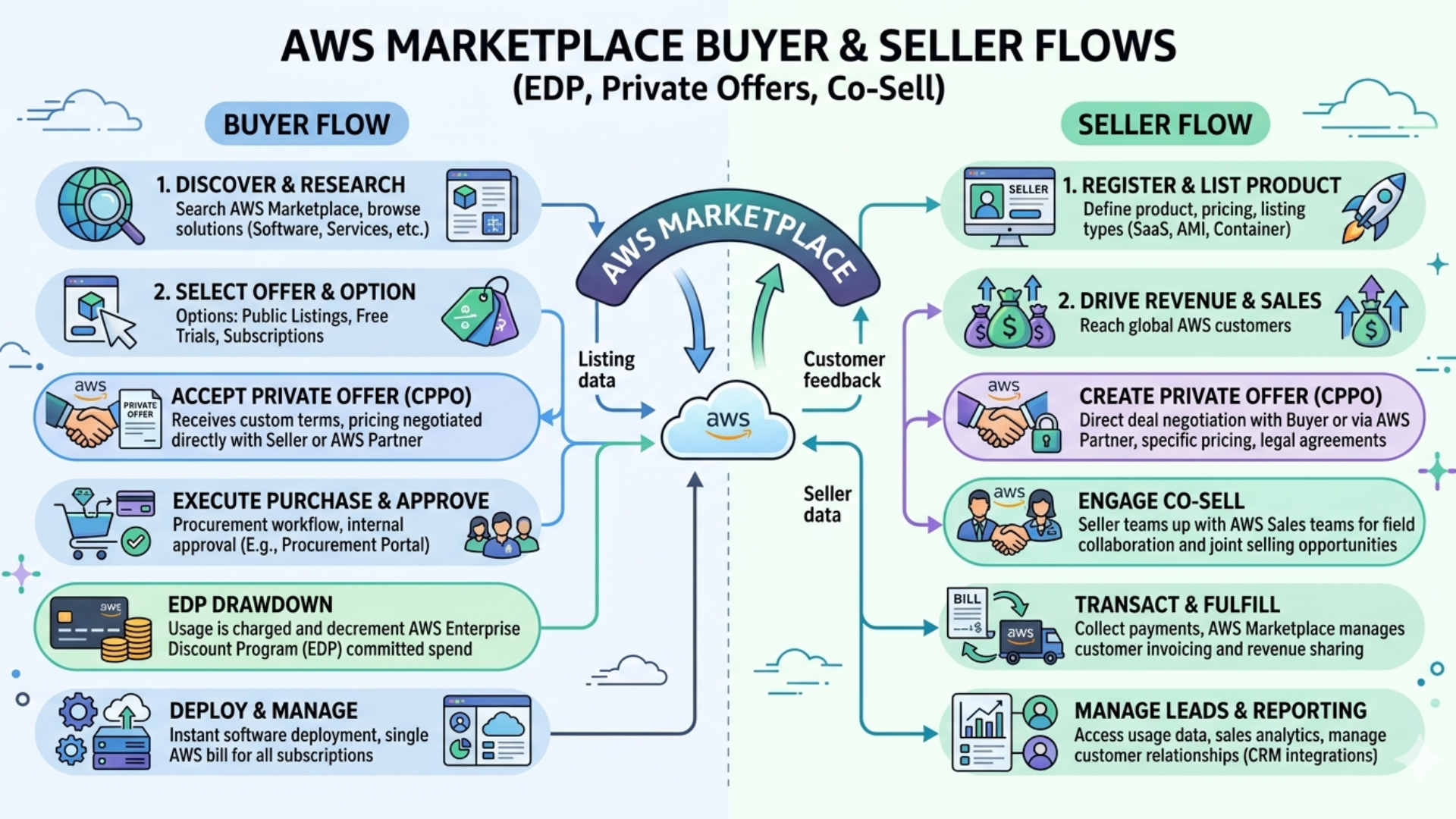
At its core, AWS Marketplace operates as a hyper-efficient dual-sided engine, bridging the gap between complex enterprise procurement requirements and scaling software sales operations. By unifying discovery, contracting, and billing into a single architectural layer, the platform removes the friction that traditionally stalls B2B software transactions.
The buyer experience: frictionless enterprise procurement
For enterprise buyers, the platform acts as a trusted, centralized procurement clearinghouse. Internal technology teams can search or browse tightly curated product categories, evaluate granular technical metadata, and subscribe to critical software assets with just a few clicks using their active corporate accounts.
- Financial consolidation: All licensing fees, consumption penalties, and renewal costs appear as a single line item on their consolidated cloud invoice.
- Strategic budget utilization: Every dollar routed through the marketplace systematically counts toward satisfying the buyer's multi-year Enterprise Discount Program (EDP) commitments.
- Procurement bypass: Because the overarching master cloud agreement is already legally active, organizations can completely bypass lengthy vendor onboarding cycles, independent legal red tape, and isolated contract negotiations. Procurement leaders heavily favor this ecosystem because it leverages pre-vetted cloud solutions and standardized licensing templates.
The seller blueprint: automated financial operations
For Independent Software Vendors (ISVs) and SaaS companies, the cloud marketplace transforms your product catalog into a high-scale transactional engine. Through a dedicated management portal, engineering and sales leaders can register diverse product types, spanning cloud-hosted SaaS, containerized systems, and machine images, while defining intricate pricing models.
- Zero-overhead collections: The underlying platform entirely absorbs the administrative burden of global billing, invoicing, and collections. The cloud provider assumes the financial risk of processing payments and distributing monthly disbursements, liberating your team to focus exclusively on pipeline velocity rather than chasing past-due invoices.
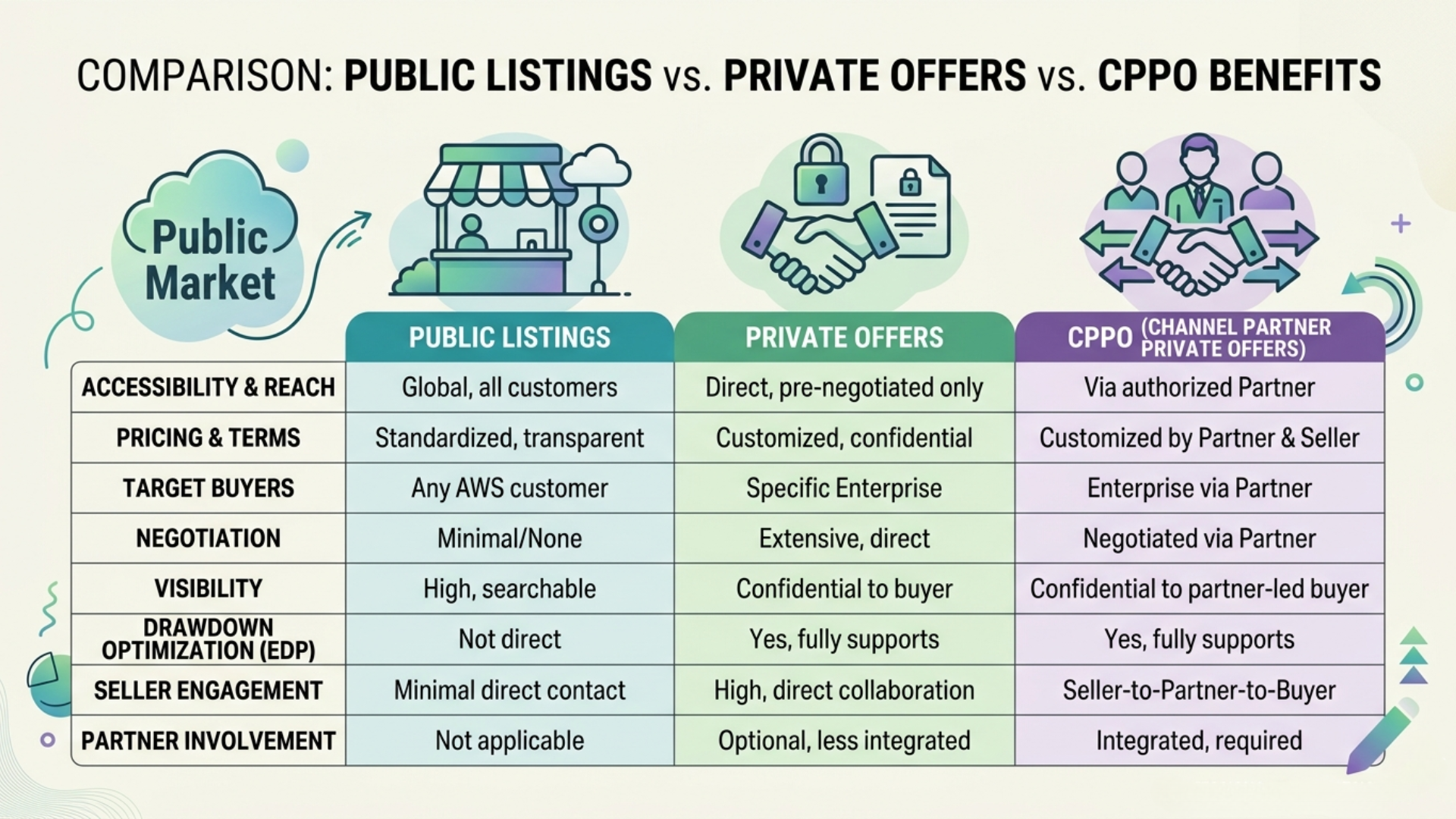
- Self-service vs. private architectures: While public catalog listings excel at capturing transactional, self-service revenue from the developer ecosystem, they only tell part of the story. The true engine of enterprise revenue growth lies in customized private offers, which consistently drive 65% to 75% of total marketplace contract value. This mechanism empowers your enterprise account executives to inject bespoke pricing, custom service-level terms, and flexible contract durations directly into a secure, pre-negotiated digital transaction.
Architecture, delivery engines, and marketplace features
The modern cloud marketplace operates as a versatile software deployment engine, supporting a diverse array of architectural configurations. These delivery models are engineered to align with complex enterprise security postures, modern DevOps workflows, and flexible procurement cycles. By eliminating custom deployment scripts and non-standardized licensing frameworks, the platform bridges the gap between independent software vendors and enterprise infrastructure.
- SaaS (Software-as-a-Service) engines
Centrally managed and hosted by the vendor, SaaS solutions are accessed seamlessly by the buyer via secure web interfaces or dedicated programmatic APIs. This remains the single most popular and streamlined integration pathway for Independent Software Vendors (ISVs) because the core application sits entirely within the vendor’s cloud footprint, shifting all maintenance overhead away from the customer. Integration centers almost exclusively on connecting backend user management with standard subscription, entitlement, and metering APIs. Buyers escape the operational burden of local deployment, patching, and infrastructure management, which drastically lowers the barrier to entry and enables real-time, consumption-based billing that scales dynamically with enterprise adoption.
- AMI-based (Amazon Machine Image) delivery
This model provides pre-configured, hardened virtual machine images designed to launch instantly on secure, isolated cloud compute instances within the customer’s own virtual private cloud (VPC). Vendors bundle their operating systems, application code, dependencies, and strict security configurations into a single, immutable machine image that can be deployed natively via Amazon EC2. This decentralized architecture is heavily favored by financial institutions, government agencies, and highly regulated enterprises. Because the software executes entirely within the buyer's secure cloud perimeter, sensitive data never leaves their boundary, satisfying strict data-sovereignty rules, internal compliance frameworks, and rigid network isolation policies.
- Containerized orchestration frameworks
This delivery vehicle supplies production-ready, OCI-compliant container images optimized for rapid deployment and automated orchestration across modern microservices environments. Software is packaged natively for seamless execution across popular managed platforms, including Amazon Elastic Container Service (ECS), Amazon Elastic Kubernetes Service (EKS), and AWS Fargate for serverless container workloads. Containerization allows enterprise engineering teams to integrate third-party software directly into their existing continuous integration and continuous deployment (CI/CD) pipelines. This ensures absolute environment predictability, rapid horizontal auto-scaling, and ultra-low resource overhead across highly distributed, cloud-native application footprints.
- Advanced machine learning models and AI agents
This cutting-edge framework offers pre-trained algorithms, deep learning neural networks, and autonomous AI agent architectures designed for native execution within enterprise artificial intelligence pipelines. These digital assets are built to deploy directly into fully managed machine learning ecosystems like Amazon SageMaker, or hooked programmatically into generative AI foundation platforms like Amazon Bedrock. This framework allows enterprise data science teams to securely acquire, test, and deploy specialized language models, predictive engines, or automated decision agents without exposing proprietary corporate datasets to external training pools, protecting corporate intellectual property while radically accelerating AI time-to-market.
Marketplace advantages and listing dynamics
Cloud-native SaaS remains the primary entry point for emerging vendors, heavily favored for its highly competitive fee structures (typically optimized at 3 percent) and automated billing frameworks that utilize integrated tracking services.
To maximize market visibility and conversion, digital storefront listings leverage a rich suite of discovery assets. This includes comprehensive technical metadata, corporate branding, interface previews, and highly structured deployment instructions. Furthermore, advanced AI-assisted optimization engines are integrated directly into the cataloging workflow to help vendors generate search-optimized, compliant documentation that significantly boosts platform discoverability.
Here is the expanded version of the section. It retains every single metric, program detail, and core advantage from your draft, but frames them in an authoritative, executive-level tone.
Strategic advantages for independent software vendors (ISVs)
Commercializing solutions via a cloud-native marketplace delivers a suite of measurable operational and financial advantages that extend far beyond baseline platform visibility. For enterprise-focused software companies, this marketplace ecosystem serves as a direct accelerator for revenue generation and market penetration.
- Unlocking committed enterprise budgets: Modern enterprises frequently operate under multi-year cloud consumption contracts containing rigid minimum spending requirements. By routing procurement through the marketplace, enterprise buyers can simultaneously deploy your specialized software while systematically satisfying their contractual spending obligations.
- Drastic compression of sales cycles: Traditional procurement bottlenecks, such as lengthy legal reviews, vendor onboarding friction, and risk assessments, are effectively bypassed. Because the master cloud agreement is already active, standard software procurement timelines shrink dramatically, frequently by 50% to 80%.
- Substantial deal-size expansion and improved win rates: Collaborative co-selling initiatives alongside cloud account management teams unlock deeper enterprise access, driving 2x faster deal closure rates and boosting average deal sizes by up to 30%. Furthermore, vendors enrolled in elite acceleration programs benefit from reduced transaction fees, dropping as low as 1.5% on customized private offers, while gaining dedicated go-to-market support.
- Instant global credibility and footprint: Listing within the catalog exposes your product line to an active base of over 330,000 global buyers. The rigorous verification process provides immediate enterprise-grade validation, allowing emerging software brands to command institutional trust from day one.
- Streamlined back-office operations: The underlying cloud infrastructure entirely absorbs the administrative burden of global invoicing, currency conversion, and collections. Sellers receive granular, real-time financial reporting that integrates directly with existing CRM platforms to maintain absolute pipeline clarity.
Market momentum and economic impact
The compounding value of co-selling is reflected directly in financial performance: software vendors who actively engage in co-sell mechanics experience 51% higher revenue growth compared to those operating in isolation. This growth aligns with a massive macroeconomic shift. Throughout 2025 and 2026, transactional volume across cloud marketplaces has accelerated aggressively, putting hyperscaler marketplace transaction values on a clear trajectory toward a projected $163 billion by 2030.
The seller journey: Getting listed and scaling
Registering as a seller involves AWS Partner Network enrollment, tax and banking setup, and product preparation. Technical integration varies by type but centers on subscription and metering APIs for SaaS.
Once live, focus shifts to private offers, ACE deal registration for co-sell, and ISV Accelerate enrollment. Many teams initially underestimate ongoing operations: listing updates, compliance, revenue reconciliation, and CRM sync.
This is where dedicated platforms shine. Missioned automates listings across marketplaces, private offer management, compliance, and CRM integration, so your team avoids portal fatigue.
Private offers, co-sell, and advanced programs
Private offers represent the real enterprise engine. You customize price, duration, payment schedules, and EULA, then send a secure link. Buyers accept without leaving their AWS console.
Channel Partner Private Offers (CPPO) extend reach through resellers while preserving Marketplace benefits. ISV Accelerate unlocks fee reductions, co-sell incentives, and AWS field team alignment.
Co-sell via ACE lets you register opportunities for joint pursuit, with AWS reps incentivized on Marketplace transactions.
Common challenges and how to overcome them
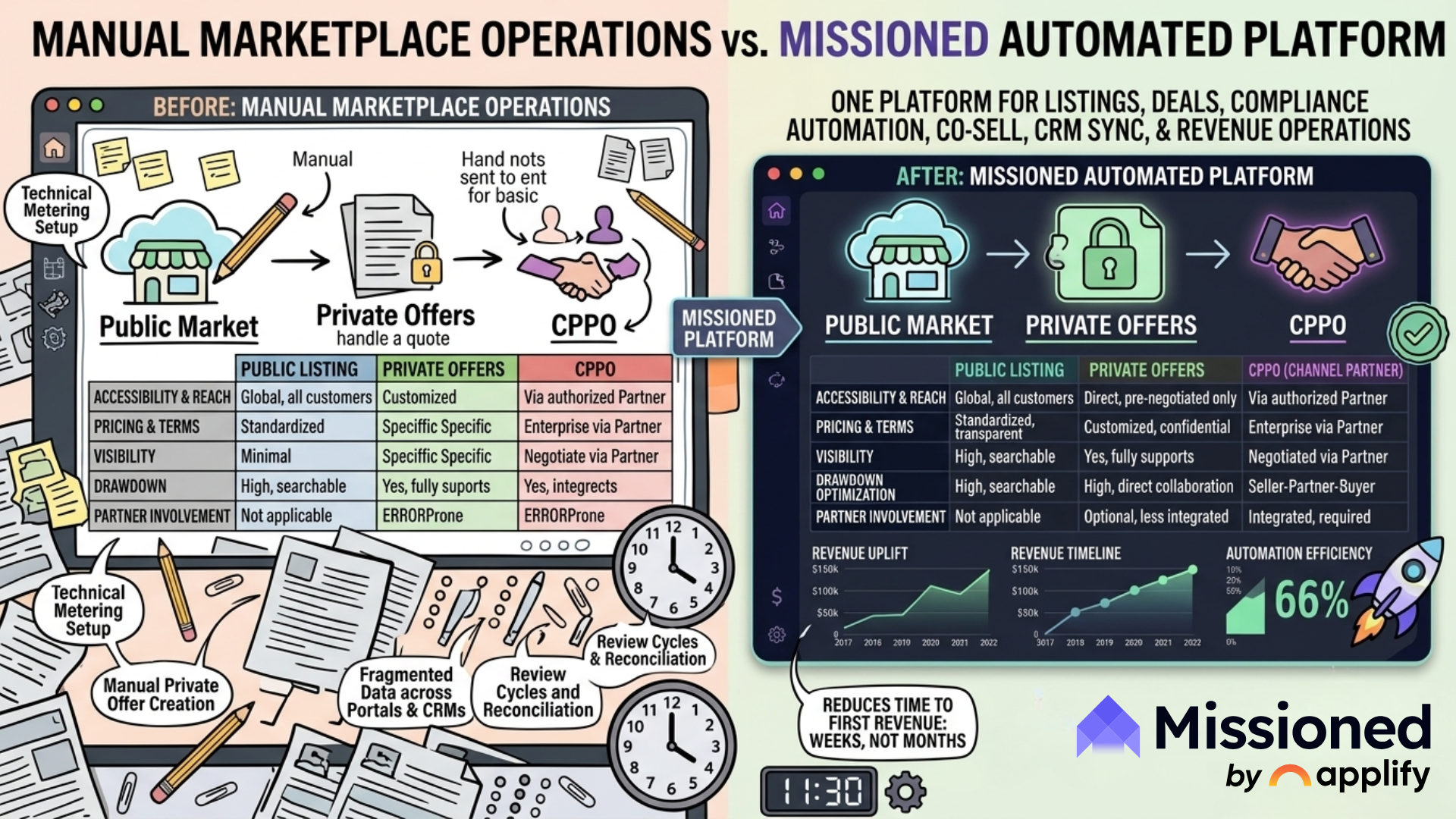
Many ISVs struggle with technical metering setup, manual private offer creation, compliance documentation, and fragmented data across portals and CRMs. Review cycles and reconciliation add friction.
Growth-stage teams rarely have dedicated marketplace ops staff. This is exactly why Missioned was built: one platform for listings, deals, compliance automation, co-sell, CRM sync, and revenue operations across AWS and Azure.
Teams using streamlined solutions report weeks, not months, to first revenue.
Real-world impact and industrial insights
In 2026, leading ISVs continue setting records. Snowflake generated around $2 billion on AWS Marketplace in 2025 alone. Okta crossed $1 billion cumulative and saw Marketplace growth outpace overall revenue significantly.
Forrester data reinforces the value: composite organizations see strong ROI, with Marketplace enabling predictable channel revenue that complements direct sales.
The shift toward solution-centric and AI-powered procurement further elevates well-positioned listings.
Why now is the time for SaaS companies
Enterprise buyers increasingly default to cloud marketplaces for third-party software. With committed spend mandates and procurement simplification, solutions listed and optimized on AWS Marketplace gain a structural advantage.
ISVs that treat it as a core channel, complete with strong listings, active private offers, and co-sell engagement, capture disproportionate growth.
FAQ
What is AWS Marketplace exactly?
AWS Marketplace is a curated digital catalog that allows enterprise buyers to discover, provision, and manage third-party software, data sets, and professional services directly within their centralized AWS infrastructure. Instead of dealing with disparate vendors, corporate buyers can purchase your software with a single click and have the costs automatically consolidated onto their existing, unified AWS invoice. This eliminates back-office accounting silos and turns the cloud provider into a friction-free clearinghouse for all of your enterprise software transactions.
Who should sell on AWS Marketplace?
This platform is built primarily for Independent Software Vendors (ISVs), B2B SaaS companies, and data providers targeting enterprise-level buyers who already operate within the cloud ecosystem. If your ideal customers are CIOs, CTOs, or procurement heads with pre-existing AWS financial commitments, having a marketplace presence is essential. It serves as a direct pipeline to pre-approved corporate budgets, allowing your sales team to completely bypass traditional vendor onboarding delays and sell directly to the world's largest enterprises.
How do private offers work on AWS Marketplace?
Private offers allow your sales team to bypass public list pricing and extend bespoke, completely confidential contract terms to a specific account. You can negotiate custom pricing tiers, flexible multi-year payment schedules, and tailored licensing clauses just like a traditional enterprise deal. Once the terms are finalized, you generate a secure, unique transaction link; the buyer simply logs into their AWS account, accepts the offer, and the contract executes instantly using their pre-configured enterprise payment methods.
What are the fees for selling on AWS Marketplace?
The standard transaction fee for cloud-hosted SaaS applications is optimized at a highly competitive 3 percent of the total deal value, which is significantly lower than traditional enterprise sales channel costs. Furthermore, for high-volume vendors who qualify for elite acceleration tracks like the AWS ISV Accelerate program, this fee drops to just 1.5 percent on customized private offers. In exchange for this nominal margin, AWS entirely absorbs the overhead and risk of global invoicing, collections, multi-currency conversions, and bad debt management.
How long does it take to get listed?
With proper preparation, a standard onboarding journey, which includes partner network enrollment, tax and banking configuration, and product metadata preparation, typically takes between 2 to 4 weeks to go live. The exact deployment timeline depends heavily on your engineering team's familiarity with integrating AWS subscription and metering APIs. While building these connections manually can occasionally bottleneck internal resources, utilizing a dedicated marketplace automation platform can compress this entire setup process down to just a few days.
Does AWS Marketplace support multi-cloud strategies?
Yes. While the transactional engine natively operates and bills within the Amazon Web Services ecosystem, the software itself can be hosted anywhere, allowing you to easily support customers with multi-cloud architectures. High-growth software providers rarely limit their revenue operations to a single storefront; the industry standard is to list products concurrently on AWS, Microsoft Azure, and Google Cloud. By leveraging a unified marketplace management platform, your team can orchestrate listings and sync private offers across all major cloud networks simultaneously.
Ready to capture committed cloud budgets?
Understanding what AWS Marketplace is marks the first step. Turning it into predictable revenue requires the right operations layer. Missioned delivers exactly that, listings, private offers, compliance, co-sell automation, CRM sync, and revenue ops in one platform purpose-built for growth-stage SaaS teams.
Book a GTM session today to see how Missioned can help your team launch or scale on AWS Marketplace faster and with less friction. Or explore our ROI calculator to model your opportunity.