


.png)



Sellers who have previously listed standard SaaS products on AWS Marketplace tend to carry a set of assumptions into their first agentic AI listing. Most of those assumptions are reasonable, given prior experience, and most of them turn out to be incomplete once the process is actually underway. The gap between expectation and reality is where the delays happen, not in the technical difficulty of the listing itself.
Listing agentic AI doesn't follow the same path as SaaS
Agentic AI products carry a categorization requirement that standard SaaS listings don't. AWS requires sellers to classify each listing as an AI Agent, or as one of several specific tool types beneath it, an MCP server, a knowledge base, or a guardrail.
This classification is not administrative. It determines how the product surfaces to buyers browsing the category, and a genuinely autonomous agent misfiled under a generic tool type will simply be absent from the search results of the buyers most likely to want it. Products that take autonomous action generally belong under AI Agent. Products that serve as infrastructure for other agents are usually better represented, and more discoverable, under the corresponding tool category.
Finishing the wizard is not the same as going live
This is the assumption most likely to cost a seller time after launch. Every new agentic AI listing begins behind an allowlist, restricted to whichever accounts the seller explicitly adds. Completing the listing wizard and submitting a fully correct listing does not change this. The product remains invisible to the broader market until the seller returns and deliberately expands access.
Teams unaware of this step often spend a confusing period after launch trying to understand why a seemingly finished listing isn't generating any visibility. The resolution is straightforward: add test accounts, validate the listing internally, then expand access toward general availability. It needs to be treated as a distinct phase of the launch, not the final click inside the wizard.
The real friction isn't inside the wizard itself
Two elements inside the wizard tend to add more time than the length of the form would suggest.
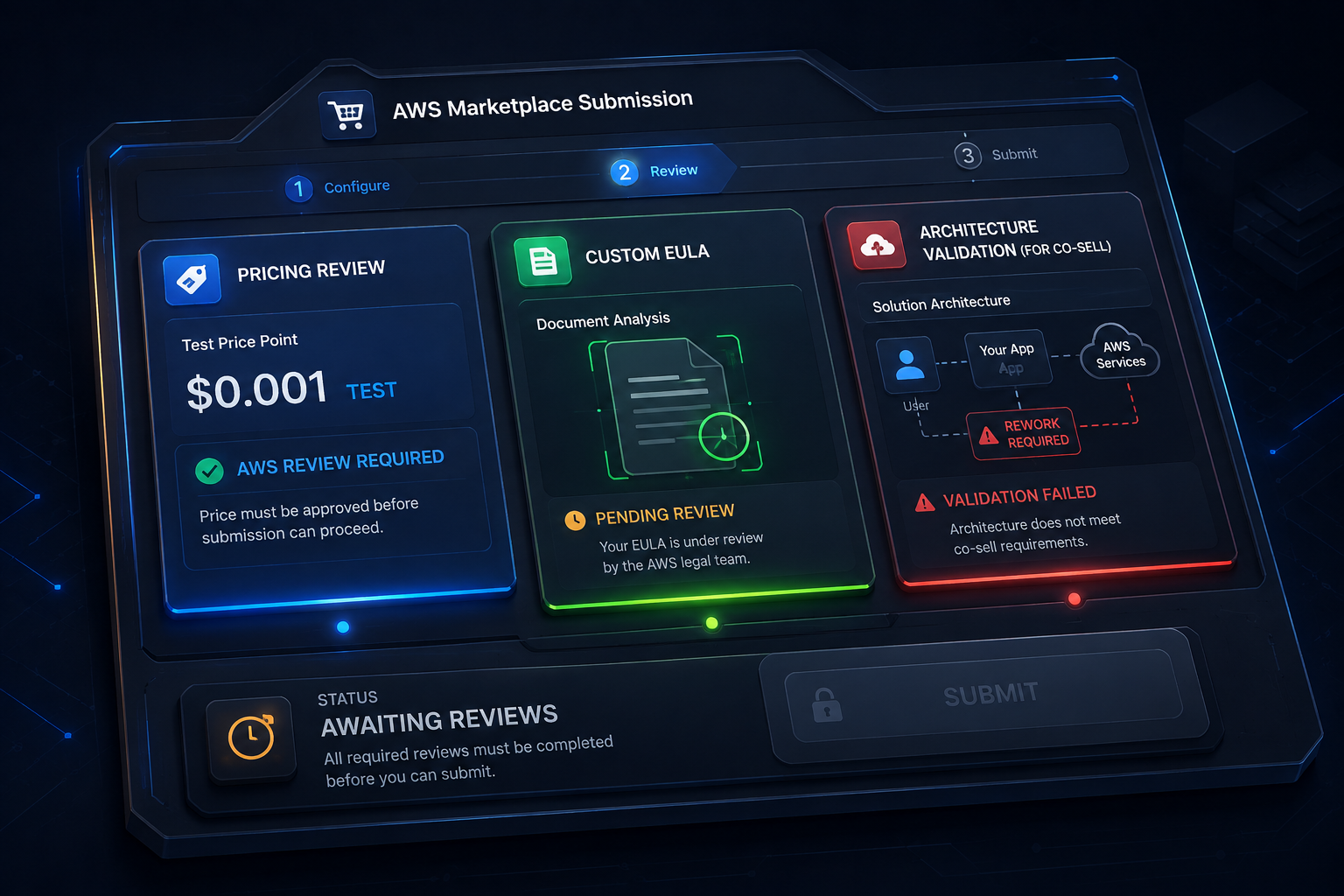
The first is pricing review. AWS requires sellers to test pricing at a nominal amount, close to $0.001, before actual pricing goes live. This step exists to catch configuration errors before a paying customer encounters them, and it extends the launch timeline meaningfully for sellers who weren't expecting a review cycle at all.
The second is the End User License Agreement. Sellers can use AWS's standard EULA or submit a custom one, and custom agreements are where most delays occur. Not because the submission process is complicated, but because drafting terms that protect the seller, satisfy AWS, and remain acceptable to buyers is a task most engineering-led teams have not done before, and one that often benefits from outside review.
Product quality alone doesn't carry a listing
A technically strong product does not automatically translate into a listing that converts. AWS's own guidelines are specific about what distinguishes the two: accurate category tagging rather than a broad classification that is merely defensible, descriptions written around one real use case rather than several vague ones, and included documentation that reduces a buyer's hesitation before subscribing rather than after. We've covered the listing process itself in more depth elsewhere, including what separates a listing that's merely complete from one that's actually competitive.
A more consequential gap sits underneath this. Architecture validation is a stated prerequisite for AWS's SaaS Co-Sell Benefit on API-based listings, and passing that validation is a distinct skill from building sound architecture in the first place. It is common for technically solid products to fail this validation on a first attempt simply because the team had not been through the process before.
Offering a trial period at no cost is a smaller consideration by comparison, but a meaningful one, since it reduces the barrier to a buyer's first evaluation more reliably than strong copy alone.
Submission marks the midpoint, not the end
Clearing AWS's review confirms that the listing exists, not that it has been found. The listing remains behind the allowlist at this stage, which means the substantive work, account provisioning, internal validation, and the progression toward broader visibility, begins after submission rather than before it.
Approaching launch day as the start of a second phase, rather than a conclusion, removes most of the surprise from the gap between a listing that is technically live and one that is genuinely visible.
Common questions first-time sellers ask
Does an agentic AI product need a different listing process than SaaS on AWS Marketplace?
Yes. Agentic AI listings require an additional categorization step, choosing between the AI Agent category and specific tool types like MCP server, knowledge base, or guardrail that standard SaaS listings don't have.
Is a new AI agent listing publicly visible as soon as it's submitted?
No. Every new listing starts behind an allowlist restricted to accounts the seller adds directly. Visibility has to be expanded deliberately after submission; it isn't automatic.
Why does AWS require a $0.001 pricing test before a listing goes live?
The nominal price review catches pricing configuration errors before a real customer encounters them, and it's a required step before actual pricing takes effect.
Does a technically sound agentic AI product automatically qualify for AWS's SaaS Co-Sell Benefit?
No. API-based listings must pass architecture validation as a separate prerequisite, and that validation tests something different from whether the underlying product works correctly.
What this comes down to
Most delay in this process traces back to an assumption carried over from a different type of listing, rather than any inherent difficulty in the agentic AI category itself. Understanding where those assumptions break down in advance is what makes the process manageable.
None of this has to be figured out alone. Missioned.ai works with AWS Partners specifically on the parts of this process that trip up first-time sellers most: co-sell eligibility, architecture validation, and getting a listing positioned to actually convert once it's visible. If your team is heading into an agentic AI listing for the first time, book a GTM strategy with our team before the architecture validation step catches you off guard.