


.png)



Buying a pretrained model or algorithm off AWS Marketplace can save you months compared to building one from scratch, and for a lot of teams, that time savings is the entire point of shopping the marketplace in the first place. It can also go badly if the evaluation is rushed, and it goes badly more often than people expect. The listing looks polished, the use case seems close enough to what you need, and three weeks later the model is underperforming in production or racking up a bill nobody budgeted for. None of that is unusual, and almost all of it is avoidable if you slow down and evaluate the listing properly before you deploy anything.
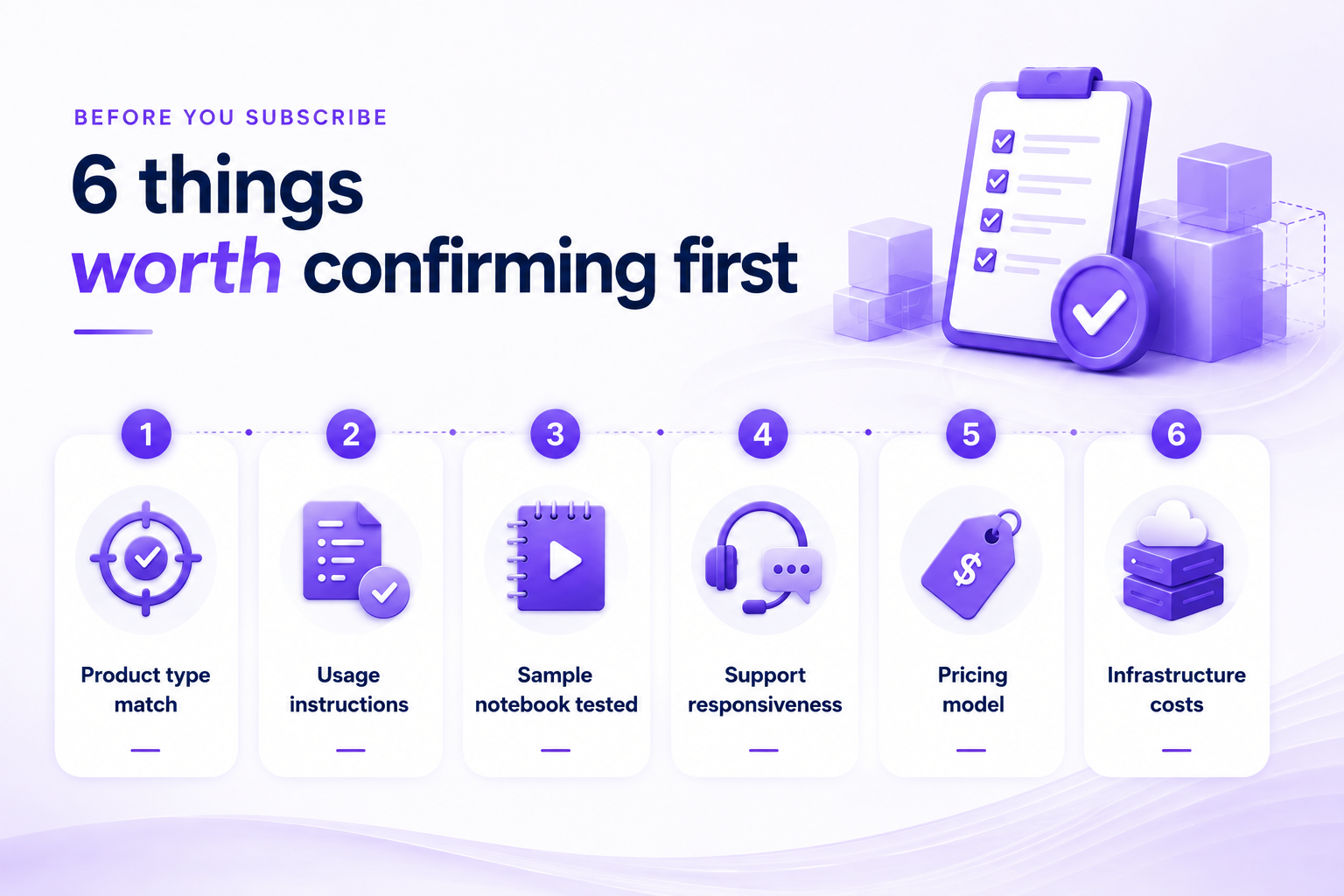
In short: before buying a machine learning model or algorithm on AWS Marketplace, confirm whether it's a model package or an algorithm, read the usage instructions rather than just the description, run the sample Jupyter notebook against your own data, check who provides support, understand which pricing model applies, and account for the infrastructure costs you'll carry separately from the software price. The rest of this article walks through each of those in order, along with why they matter more than they might seem to at first glance.
Know what you're actually buying
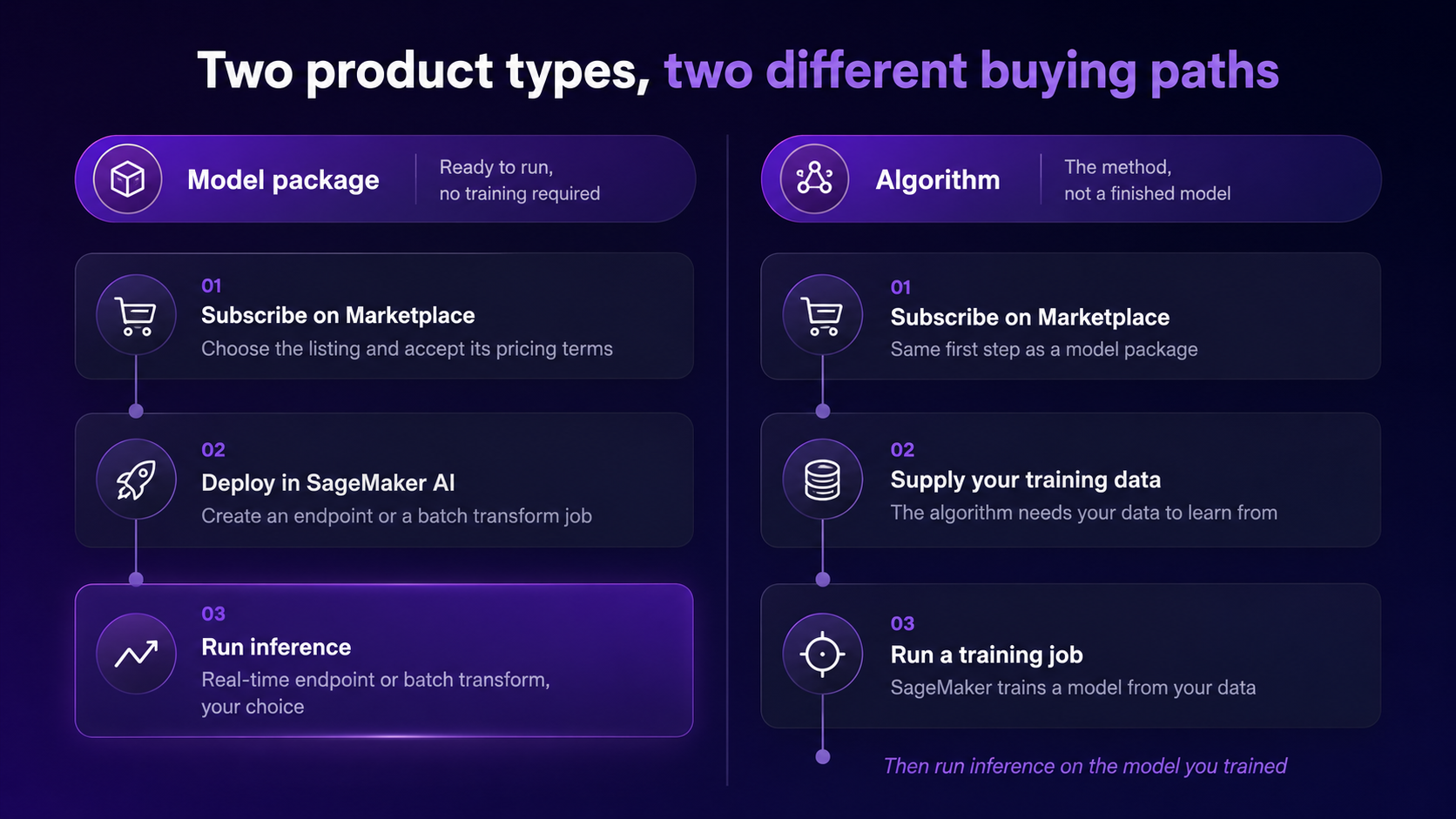
AWS Marketplace lists two distinct types of SageMaker AI products under its machine learning category, and they are not interchangeable, even though it's easy to assume they are if you're moving quickly through a list of search results.
A model package is a pretrained model that's ready to make predictions without any further training on your end. You subscribe to it, deploy it, and start running inference almost immediately.
An algorithm works differently. It includes the training component, but it requires you to supply your own training data before it can make any predictions at all. In other words, you're buying the method rather than a finished model, and the value you get out of it depends heavily on the data you feed into it.
This distinction changes what evaluation even means for a given listing. Evaluating a model package is mostly about whether the pretrained model fits your use case as it stands. Evaluating an algorithm is about whether the training approach, combined with your available data, will actually produce a model that fits your use case, which is a more involved question with more room for things to go sideways. Get this part wrong at the start, and every evaluation step that follows ends up aimed at the wrong target entirely.
If you're new to how AWS Marketplace works more broadly, this overview of what AWS Marketplace is is a useful primer before diving into the machine learning category specifically.
What to check before you subscribe
AWS gives buyers a defined set of things to review before subscribing to a listing: the product description, the usage instructions, customer reviews, sample Jupyter notebooks, pricing, and support information. Most buyers skim through all six without really stopping on any of them. Few actually weigh them the way they should, and that's usually where the trouble starts.
Product description and usage instructions. It helps to read past the marketing language and get into the usage instructions specifically, since that's where the real constraints tend to show up. A product description can claim broad applicability while the usage instructions quietly reveal narrow assumptions about input format, data volume, or preprocessing steps that your existing pipeline doesn't already handle. As the old saying goes, you shouldn't judge a book by its cover, and a Marketplace listing is very much a cover.
Customer reviews. These are useful for catching integration problems and getting a sense of how responsive a seller's support actually is, but they're less useful for judging model accuracy, mostly because reviews rarely include the reviewer's dataset or their evaluation methodology. It's better to treat reviews as a signal about the seller's reliability rather than a substitute for testing the model yourself.
Sample Jupyter notebooks. This is the step buyers skip most often, and it's also the one they regret skipping most often. A notebook lets you run the model against a small sample of your own data before you commit to a subscription, which is by far the fastest way to catch a mismatch between what the listing claims and what the model actually does once it's in front of real inputs. If a listing doesn't include a notebook at all, that absence is worth treating as a signal in itself.
Support information. It's worth knowing, ahead of time, who you'd actually reach if the model breaks or starts behaving unexpectedly in production, and roughly how quickly you could expect a response, before you're depending on it for something business-critical.
These listings are built by the sellers who publish them, and understanding how AWS Marketplace listings actually get created can help explain why some listings are far more thorough than others. In a lot of cases, the quality of a listing simply reflects how seriously the seller treated the listing process to begin with.
Security and validation you don't have to do yourself
Amazon SageMaker AI runs a static scan on all Marketplace machine learning products before they're listed, as part of providing a secure environment for training and inference jobs. That gives you a baseline of validation you don't need to repeat on your own, which is genuinely useful and saves you a step.
What it doesn't cover is whether the model performs well on your specific data, whether its outputs meet your accuracy requirements, or whether its licensing terms actually fit your intended use case. The static scan is a floor rather than a ceiling, and it's not a substitute for your own testing through the sample notebook, no matter how reassuring it might feel to see that a listing has already passed some kind of check.
Pricing models to understand before you commit
Pricing for SageMaker AI products on Marketplace works differently depending on the product type and how you plan to run it, and this is another place where measuring twice and cutting once pays off. Sellers can charge an hourly rate per instance type, with usage tracked and billed down to the minute. For model package products specifically, you can run inference in two different ways: a continuously hosted endpoint for real-time predictions, or a batch transform job against a dataset, and sellers are free to set different pricing for each of those paths.
You're also responsible for the underlying infrastructure costs in your own AWS account, and those costs sit separately from whatever the seller charges for the software itself. A buyer who only pays attention to the software price, without accounting for the infrastructure cost underneath it, can end up with a bill that looks nothing like what they originally expected. Some listings offer a trial period at no cost before charges begin, and that's worth checking before you assume you're already locked into paying anything.
A short evaluation checklist
Before subscribing to any machine learning model or algorithm on AWS Marketplace, confirm the following:
Frequently asked questions
What's the difference between a model package and an algorithm on AWS Marketplace? A model package is a pretrained model ready for inference without further training, while an algorithm includes the training component and requires you to supply your own training data before it produces predictions.
Does AWS Marketplace test machine learning products for accuracy before listing them? No. AWS runs a static security scan on all machine learning listings, but that scan doesn't evaluate model accuracy or performance on your specific data, which is why testing through the sample notebook still falls on the buyer.
How is pricing calculated for machine learning products on AWS Marketplace? Sellers typically charge an hourly rate per instance type, and for model packages, pricing can differ between real-time inference endpoints and batch transform jobs. Buyers also pay for infrastructure costs in their own AWS account, separate from the software price.
What's the single most important thing to check before buying a machine learning model? Running the sample Jupyter notebook against your own data. It's the fastest way to confirm the model behaves the way the listing claims, and it catches the kind of mismatch that pricing details alone won't reveal.
The step that actually separates good evaluations from rushed ones
Almost every bad Marketplace purchase traces back to skipping the notebook, not misreading the pricing. Pricing mistakes are usually recoverable, an unsubscribe away at worst. A model that doesn't behave the way the listing implied, discovered only after it's already sitting in production, costs a lot more to unwind, and by then the damage tends to have spread further than anyone anticipated. An evaluation that takes an extra hour to actually run the sample notebook against real data will catch that kind of mismatch before it becomes a production problem, and that, in the end, is the entire point of doing the evaluation at all.