


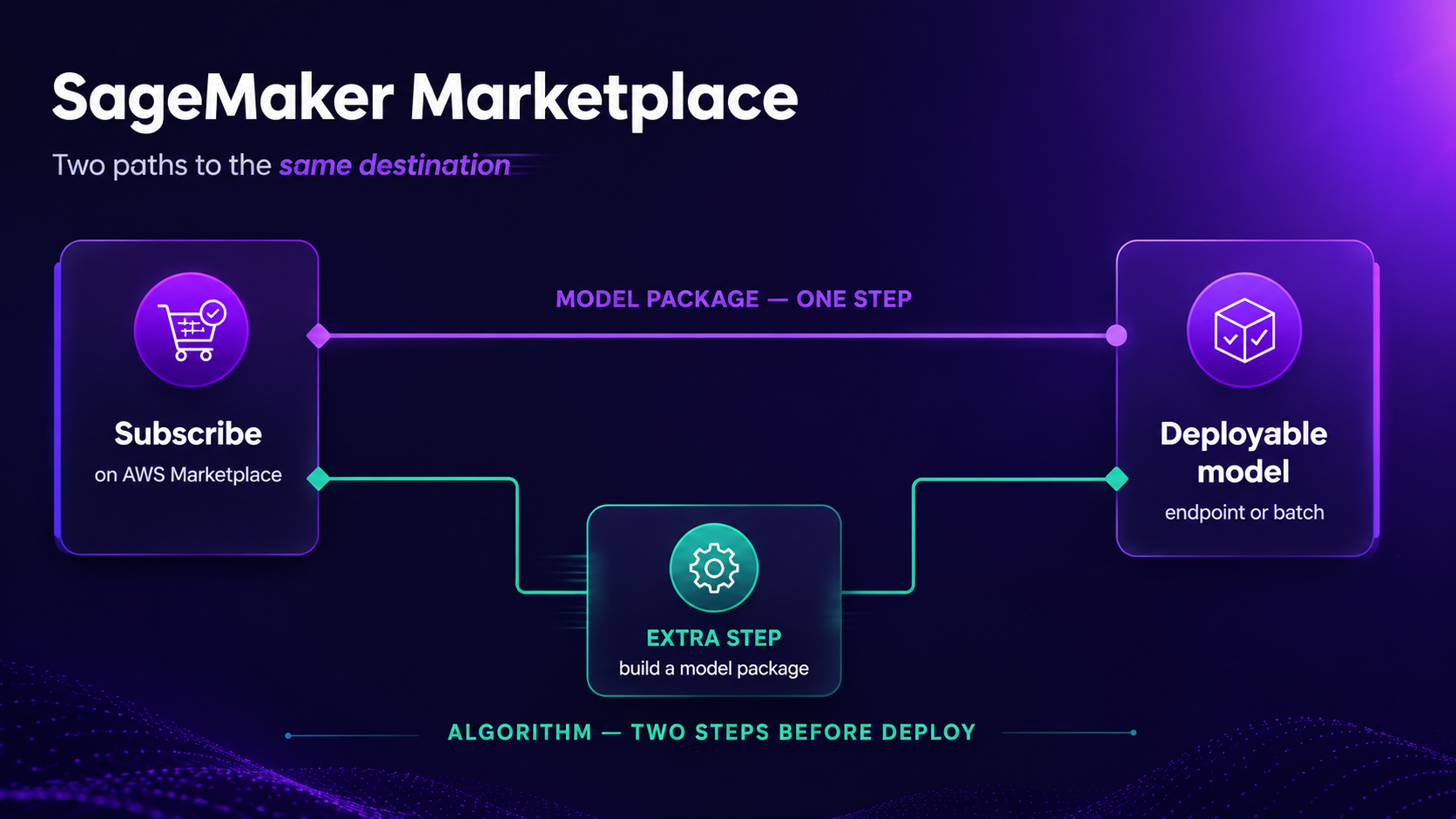



SageMaker Marketplace isn't a separate marketplace at all, and that trips people up more often than you'd expect. It's the machine learning category inside AWS Marketplace, the part where Amazon SageMaker AI integrates directly with AWS's curated catalog so developers can charge other SageMaker AI users for the use of their algorithms and model packages. AWS Marketplace itself spans thousands of listings across categories like security, networking, storage, business intelligence, and DevOps, and the SageMaker-connected slice of it is specifically where machine learning products live. If you want the fuller picture of how the platform works beyond machine learning specifically, our overview of AWS Marketplace is a good place to start.
In short: SageMaker Marketplace refers to the integration between Amazon SageMaker AI and AWS Marketplace, where buyers can find and subscribe to two types of machine learning products, algorithms and model packages. A model package is a pretrained model ready to use right away. An algorithm requires you to bring your own training data first, and importantly, once training finishes, you then have to build a model package from the results before you can actually run inference. The rest of this article walks through why that distinction matters and how the deployment side works in practice.
The two product types, and why they're not interchangeable
Both product types exist to get you to the same destination, a deployable model you can run inference against, but they take genuinely different roads to get there.
A SageMaker AI model package is a unique, pretrained model, identified by its own Amazon Resource Name, that's ready to use as soon as you subscribe. As a seller, you can either train this model using SageMaker AI yourself or bring one you've already trained elsewhere. As a buyer, you use it to create a model directly, no extra steps required before you can start making predictions.
A SageMaker AI algorithm, on the other hand, has two logical components, training and inference, and it's the method rather than the finished product. You bring your own dataset, use the algorithm's training component to run a training job in SageMaker AI, and SageMaker AI saves the resulting model artifacts to an Amazon S3 bucket on your behalf. Here's the part that catches people off guard, subscribing to an algorithm isn't the end of the process, it's closer to the beginning. Once training completes, you have to use those model artifacts to build a model package of your own before you can deploy anything and start getting predictions out of it.c
.png)
If you're weighing which type actually fits your situation before you buy, our guide on buying a machine learning model goes through the practical side of that decision in more detail, including what to check in a listing before you commit to either path.
How deployment actually works, either way
Once you've got a deployable model, whether it came from a model package or from an algorithm you trained yourself, there are two ways to put it to work, and the choice comes down to how you plan to use it.
Endpoint deployment stands up a persistent API you can call whenever you need a prediction. SageMaker AI hosts the model, creates the endpoint, and keeps it running until you stop it yourself, which makes this the right fit for applications that need real-time responses on an ongoing basis.
Batch transform is built for the opposite scenario, a one-off job that runs inference across an entire dataset in one pass rather than sitting there waiting for requests. If you've got a large batch of records to score all at once, this saves you from paying for an endpoint that's just sitting idle between runs.
.png)
Neither approach is inherently better than the other, and it's genuinely just a question of matching the deployment method to the shape of your workload, real-time and ongoing versus batched and periodic. For a closer look at how sellers structure these listings in the first place, how AWS Marketplace listings actually get created covers the seller side of that same process.
Security, and what happens behind the scenes
When a buyer subscribes to a containerized product, whether that's an algorithm or a model package, the Docker containers run in an isolated environment with no internet access. Sellers building these products can't rely on making outgoing calls to the internet, and calls to other AWS services aren't allowed either, which keeps buyer data contained within the boundaries of the job itself. That's a security detail worth knowing even as a buyer, since it means the model you're running isn't quietly phoning home while it processes your data, a small thing, but one that matters more than it might seem at first glance.
Frequently asked questions
Is SageMaker Marketplace a different platform from AWS Marketplace? No. SageMaker Marketplace describes the integration between Amazon SageMaker AI and AWS Marketplace, not a separate site. Machine learning listings live inside AWS Marketplace itself, under the categories tied to SageMaker AI.
What's the difference between an algorithm and a model package? A model package is a pretrained model ready to use immediately after subscribing. An algorithm requires you to supply your own training data, run a training job, and then build a model package from the resulting artifacts before you can deploy anything.
Do I need to do anything after subscribing to an algorithm before I can use it? Yes. Unlike a model package, an algorithm only gets you to the training stage. You still need to run the training job with your own data and then create a model package from the output before you can deploy the model for inference.
Which deployment method should I use, an endpoint or batch transform? Use an endpoint if you need real-time predictions on an ongoing basis. Use batch transform if you have a dataset you want to score all at once and don't need a persistent, always-on API.
The distinction that actually matters
If there's one thing worth taking away from all of this, it's that buying a machine learning product on AWS Marketplace doesn't mean the same thing depending on which type you pick. A model package gets you to a working model in one step. An algorithm gets you to a working model in two, and skipping past that second step is exactly how a buyer ends up confused about why their subscription doesn't seem to be producing predictions yet. Knowing which road you're on before you start is half the battle, and it's the kind of detail that's easy to miss if you're moving fast through a Marketplace search.